Within Seasonality
When Fads Move Faster Than Factory Plans
Fads can make a toy theme rise and fade quickly, forcing LEGO to refresh products without losing the value of its brick system.
On this page
- How fashion sensitive demand changes toy lifecycles
- Why retailers push fad risk upstream
- How LEGO turns short lived themes into reusable learning
Page outline Jump by section
Introduction
Toy fads shorten LEGO product lifecycles because children’s attention often moves faster than industrial planning. A successful theme can surge on the back of a film release, game franchise, collectible craze or character trend, then cool before the next retail cycle is complete. For LEGO, this creates a structural tension: its core brick system is designed for long-term compatibility, but many of the themes that drive excitement are temporary. The result is a business that must repeatedly refresh products, retire underperforming lines and absorb demand swings without undermining the enduring value of the LEGO system itself.
 This pressure sits at the centre of LEGO’s broader volatility challenge. The company has to make decisions about design, manufacturing and retail distribution months before it knows whether a licensed property or cultural trend will still matter when sets reach shelves. Rather than eliminating that uncertainty, LEGO has increasingly treated it as a source of learning, using short-lived themes to test demand while keeping the underlying brick platform stable.[LEGO]lego.comAnnual Report 2004 ENGAnnual Report 2004 LEGO GroupApril 26, 2005 — ised by here-today-gone-tomorrow fads, which shorten the market life cycle of products…
When Fads Move Faster Than Factory Plans
The toy market combines two difficult characteristics: heavy seasonality and rapidly changing tastes. Demand is concentrated around holidays and gift-giving periods, yet the products most likely to succeed can change unexpectedly. A blockbuster film, viral game or emerging character franchise can redirect consumer attention in a matter of months.
LEGO itself highlighted this challenge during its early-2000s crisis. In its 2004 annual report, the company described a market characterised by “here-today-gone-tomorrow” fads that shorten product lifecycles while toy sales remain heavily concentrated in the final months of the year.[LEGO]lego.comthese are impressive builds for display. Shop Products…
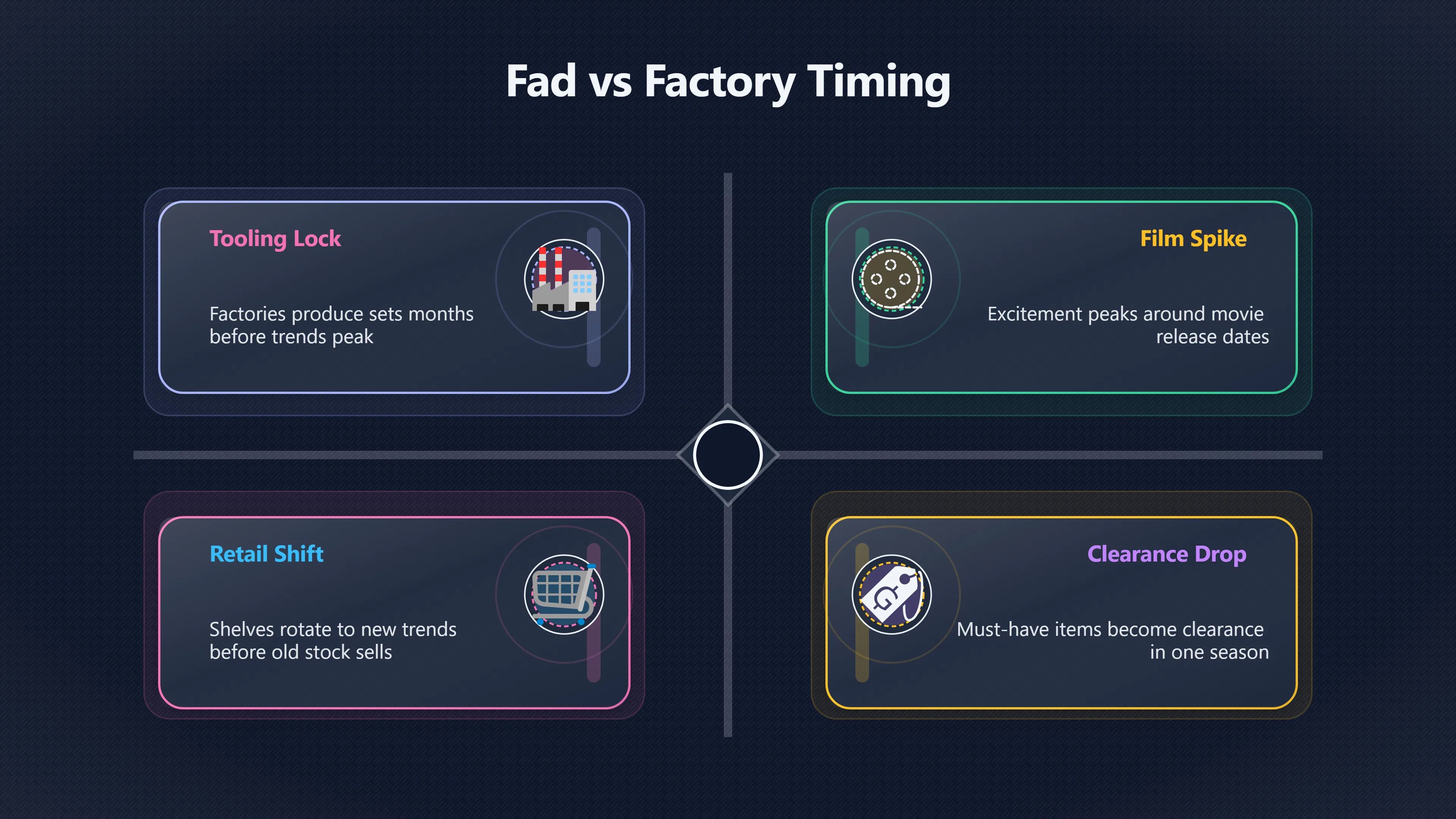
This creates a timing problem. Tooling, packaging, marketing plans and retailer commitments are arranged long before children decide what they want. By the time a trend becomes obvious, factories may already be producing a different assortment. Conversely, by the time a successful fad-inspired set reaches full production, consumer attention may already be moving elsewhere.
Unlike evergreen categories such as basic construction bricks or traditional board games, fad-driven toys face a shrinking window in which full-price demand exists. A product can move from must-have item to clearance stock in a single retail season.
How fashion-sensitive demand changes toy lifecycles
The shortening effect comes from several overlapping mechanisms:
- Media-linked excitement decays quickly. A film tie-in often peaks around release dates and promotional campaigns.
- Children age out of trends rapidly. What feels essential to an eight-year-old this year may feel outdated next year.
- Collectible culture rewards novelty. New characters and limited releases continually replace older favourites.
- Digital entertainment accelerates attention shifts. Games, streaming content and online communities create faster trend cycles than traditional television-era toy markets.
Industry research has repeatedly identified short product lives, rapid turnover and unpredictable demand as defining characteristics of the toy sector. These dynamics resemble fashion retail more than traditional manufacturing, because consumer interest itself becomes a moving target.[ResearchGate]researchgate.netLessons in Managing Supply Chain Risk from the Toy…Like the high-technology industry, toys also suffer from many supply ch…
Why Retailers Push Fad Risk Upstream
Short toy lifecycles become even more challenging because retailers increasingly avoid carrying large inventories themselves. Large chains want shelves filled with current winners, not products whose popularity may have peaked.
LEGO’s 2004 discussion of market risks linked fad-driven demand directly to retailer behaviour. The company pointed to lower retailer inventories, demands for shorter delivery times and increasing pressure on margins alongside the problem of short-lived toy fashions.[LEGO]lego.comA short presentationLEGO® play experiences enable learning through play by encouraging children to reason systematically and think creati…
The practical effect is that risk migrates upstream.
If a retailer is uncertain about a theme’s long-term appeal, it can order conservatively and reorder only if sales prove strong. The manufacturer then bears more of the forecasting burden. LEGO must decide:
- How many sets to produce before demand is proven.
- How much factory capacity to dedicate to a theme.
- Whether to invest in a second or third wave of products.
- When to discontinue a line before inventory becomes obsolete.
This is especially difficult for licensed themes connected to films, television series or game franchises. Licensing agreements often require LEGO to commit resources before market demand is fully visible, while retailers reserve the option to adjust orders as consumer tastes evolve.
The result is a compressed commercial lifecycle. A theme may have only a brief period in which it receives premium shelf space, active marketing support and full-price demand before retailers begin allocating space to the next trend.

Why Licensed Themes Age Faster Than the Brick System
One of LEGO’s most important adaptations has been separating the lifespan of a theme from the lifespan of the building system underneath it.
Licensed themes based on major entertainment properties can generate enormous sales. Over the years, LEGO has built ranges around franchises such as Star Wars, Harry Potter, Marvel and many others. These partnerships allow LEGO to attach its products to existing fan communities and cultural events.[Brickipedia]brickipedia.fandom.comBrickipedia Licensed themes | BrickipediaLicensed themes | Brickipedia - FandomLicensed themes are any themes which involve another license. Mainly based on TV series…
Yet the popularity curve of a licensed theme is rarely as durable as the brick platform itself.
A spaceship tied to a film release may experience a sales spike that lasts months rather than years. Character-driven products can become dated when a franchise pauses, a television series ends or a new generation of consumers adopts different favourites.
LEGO therefore faces a dual lifecycle:
LevelTypical lifespanIndividual setOften one to three yearsTheme popularity peakCan be shorter and tied to cultural momentsCore building systemDecadesBasic brick compatibilityGenerational
This distinction is crucial for understanding LEGO’s resilience. The company can retire a theme without abandoning the manufacturing, engineering and design capabilities behind it. A mould created for one product may support future products. Building techniques developed for a licensed set can reappear elsewhere. Minifigure design expertise accumulates even when specific characters disappear.
How LEGO Turns Short-Lived Themes Into Reusable Learning
An antifragile organisation does not simply survive volatility; it extracts information from it. LEGO’s response to fad-driven lifecycles increasingly follows this logic.
Instead of treating every discontinued theme as a failure, the company can use short-lived products as experiments that generate knowledge.
Several forms of learning emerge:
Demand signals arrive quickly
Fast-rising themes provide immediate feedback about what consumers currently value. Successful launches reveal preferences in:
- Character design.
- Price sensitivity.
- Play patterns.
- Display-oriented collecting.
- Digital integration.
Because fad-driven products move quickly, they generate data quickly.
Design techniques survive after themes disappear
Many building innovations outlive the themes that introduced them. New construction methods, specialised elements or packaging approaches can migrate into future product lines.
The temporary product becomes a test environment for permanent capabilities.
Licensing teaches portfolio management
Licensed themes expose LEGO to outside intellectual properties, but they also teach the company how to manage dependence on external cultural trends.
One lesson from the company’s difficult period in the early 2000s was that diversification without sufficient control could create complexity faster than value. Later LEGO strategies became more selective about balancing licensed products with internally owned themes.[Strategy]strategy-business.comStrategy+businessRebuilding Lego, Brick by BrickAugust 29, 2007 — 29 Aug 2007 — From the mid-1990s through 2004, the Lego Group moved int…[business]strategy-business.comStrategy+businessRebuilding Lego, Brick by BrickAugust 29, 2007 — 29 Aug 2007 — From the mid-1990s through 2004, the Lego Group moved int…
Evergreen themes absorb volatility
A fad may disappear, but LEGO City, Creator, Technic and other long-running lines remain. Strong evergreen themes act as stabilisers that reduce dependence on any single trend. Analysts reviewing LEGO’s performance have repeatedly noted the importance of balancing licensed successes with durable in-house product families.[The Rambling Brick]ramblingbrick.comThe Rambling Brick What Are The Most Popular LEGO® Themes?14, 2021 — 14 Mar 2021 — Among the top selling lines in 2015 were core themes like LEGO City, LEGO Star Wars™, LEGO NINJA…
The Antifragile Value of Short Product Lifecycles
At first glance, short product lifecycles appear to be purely a risk. They increase forecasting errors, create inventory exposure and make demand less predictable. Yet for LEGO, they also provide continuous pressure to adapt.
A company selling only permanent, unchanging products could become complacent. Fad-driven markets force constant experimentation with themes, storytelling, licensing, retail strategy and consumer engagement. The challenge is ensuring that experiments occur at the level of themes rather than at the level of the core system.
That distinction helps explain why LEGO has remained more durable than many toy fads themselves. Cultural trends rise and fall, retailers rotate shelf space and entertainment franchises cycle through periods of popularity. The individual product lifecycle becomes shorter, but the brick platform accumulates experience from each cycle.
In that sense, toy fads do more than shorten LEGO product lifecycles. They repeatedly stress-test the company’s ability to convert temporary excitement into long-term capability. The faster trends move, the more valuable it becomes to separate what changes quickly from what remains reusable.[LEGO]lego.comAnnual Report 2004 ENGAnnual Report 2004 LEGO GroupApril 26, 2005 — ised by here-today-gone-tomorrow fads, which shorten the market life cycle of products…[ResearchGate]researchgate.netLessons in Managing Supply Chain Risk from the Toy…Like the high-technology industry, toys also suffer from many supply ch…
Amazon book picks
Further Reading
Books and field guides related to When Fads Move Faster Than Factory Plans. Use these as the next step if you want deeper reading beyond the article.
Hit Makers: How Things Become Popular
Connects strongly to toy crazes, licensed themes, popularity cycles, and changing consumer tastes.
The Innovator's Dilemma: The Revolutionary Book That Will Cha...
Explains how established firms adapt to changing markets, product lifecycles, and disruptive shifts in consumer demand.

Antifragile: Things That Gain from Disorder
Provides the core framework for benefiting from volatility, uncertainty, and unpredictable market shifts.

The Tipping Point: How Little Things Can Make a Big Difference
Directly helps explain toy fads, viral demand shifts, and why products suddenly surge or collapse.
eBay marketplace picks
Marketplace Samples
Topic-anchored marketplace searches for visual, collectible, or second-hand items related to this page.



Endnotes
1.
Source: lego.com
Title: Annual Report 2004 ENG
Link:https://www.lego.com/cdn/cs/aboutus/assets/blt07abb4b8a3da3f39/Annual_Report_2004_ENG.pdf
Source snippet
Annual Report 2004 LEGO GroupApril 26, 2005 — ised by here-today-gone-tomorrow fads, which shorten the market life cycle of products...
Published: April 26, 2005
2.
Source: researchgate.net
Link:https://www.researchgate.net/publication/271812956_Learning_From_Toys_Lessons_in_Managing_Supply_Chain_Risk_from_the_Toy_Industry
Source snippet
Lessons in Managing Supply Chain Risk from the Toy...Like the high-technology industry, toys also suffer from many supply ch...
3.
Source: lego.com
Link:https://www.lego.com/en-us/themes
Source snippet
these are impressive builds for display. Shop Products...
4.
Source: lego.com
Link:https://www.lego.com/cdn/cs/aboutus/assets/blt4ee78e0776fce92f/LEGO_Company_Profile.pdf
Source snippet
A short presentationLEGO® play experiences enable learning through play by encouraging children to reason systematically and think creati...
5.
Source: researchgate.net
Link:https://www.researchgate.net/publication/357612063_Research_on_Lego_Multi-channel_Development_Success_and_Improvement
Source snippet
for Lego, including [Lego games]({{ 'lego-games/' | relative_url }}), Lego movies, and Legoland...
6.
Source: brickipedia.fandom.com
Title: Brickipedia Licensed themes | Brickipedia
Link:https://brickipedia.fandom.com/wiki/Licensed_themes
Source snippet
Licensed themes | Brickipedia - FandomLicensed themes are any themes which involve another license. Mainly based on TV series...
7.
Source: strategy-business.com
Link:https://www.strategy-business.com/article/07306
Source snippet
Strategy+businessRebuilding Lego, Brick by BrickAugust 29, 2007 — 29 Aug 2007 — From the mid-1990s through 2004, the Lego Group moved int...
Published: August 29, 2007
8.
Source: ramblingbrick.com
Title: The Rambling Brick What Are The Most Popular LEGO® Themes?
Link:https://ramblingbrick.com/2021/03/14/what-are-the-most-popular-lego-themes-annual-report-review/
Source snippet
14, 2021 — 14 Mar 2021 — Among the top selling lines in 2015 were core themes like LEGO City, LEGO Star Wars™, LEGO NINJA...
Published: March 14, 2021
Additional References
9.
Source: cfocentre.com
Link:https://www.cfocentre.com/sg/true-toy-story-legos-incredible-turnaround-tale-2/
Source snippet
A True Toy Story: LEGO's Incredible Turnaround TaleThe story of how LEGO, the family-owned toy company went from teetering on the brink o...
10.
Source: templeofbricks.com
Link:https://www.templeofbricks.com/en/lego-themes/
11.
Source: facebook.com
Link:https://www.facebook.com/Think.Marketing.Magazine/posts/as-part-of-how-brands-are-adapting-with-technological-advancements-lego-is-joini/1336896601796149/
Source snippet
As part of how brands are adapting with technological...LEGO is blending tech into their famous brick experience through interactive sys...
12.
Source: linkedin.com
Link:https://www.linkedin.com/posts/ramlijohn_how-lego-went-from-near-bankruptcy-to-77-activity-7039602385001873408-pkCU
Source snippet
How Lego went from near bankruptcy to $7.7 billion salesHow Lego came back from near bankruptcy to $7.7 billion in annual sales (with 5 m...
13.
Source: toyindustries.eu
Link:https://www.toyindustries.eu/resources/studies-reports/
Source snippet
Studies & reportsTIE's EU Toy Safety report: The problem of unreputable sellers on online marketplaces. June 17, 2020 | Studies and repor...
Published: June 17, 2020
14.
Source: wsj.com
Link:https://www.wsj.com/business/retail/lego-sales-hit-record-as-mix-of-homegrown-licensed-sets-drive-growth-08ac5aa1
Source snippet
The company's strong performance was driven by rising demand for both original and licensed sets such as Lego City, Technic, Botanicals...
15.
Source: noerr.com
Link:https://www.noerr.com/en/insights/new-european-toy-safety-regulation-2025-2509-comes-into-force-key-points-at-a-glance
Source snippet
New European Toy Safety Regulation 2025/2509 comes...4 Feb 2026 — The new European Toy Safety Regulation 2025/2509 has been in force sin...
16.
Source: bricknerd.com
Title: legos financial history part 1 the ides of march 2000 to 2001 7 27 23
Link:https://bricknerd.com/home/legos-financial-history-part-1-the-ides-of-march-2000-to
Source snippet
LEGO's Financial History, Part 1: The Ides of March, 2000...27 Jul 2023 — The LEGO Group's loss booked in the 2004 Annual Repor...
Published: march 2000
17.
Source: eversheds-sutherland.com
Title: eu toy safety regulation redefines product safety standards
Link:https://www.eversheds-sutherland.com/en/slovakia/insights/eu-toy-safety-regulation-redefines-product-safety-standards
Source snippet
EU: Toy Safety Regulation redefines product safety standards2 Jul 2025 — The Toy Safety Regulation (TSR) is expected to become law in Jul...
18.
Source: europarl.europa.eu
Title: toy safety how the revised eu rules protect children
Link:https://www.europarl.europa.eu/topics/en/article/20211202STO18649/toy-safety-how-the-revised-eu-rules-protect-children
Source snippet
safety: how the revised EU rules protect children | Topics25 Nov 2025 — The EU wants to make sure that toys sold on the EU market do not...
Topic Tree