Within Complexity
When More LEGO Products Hurt the Core
LEGO's 2003 report showed that more products could weaken the company when new lines stole demand from the brick system.
On this page
- What LEGO admitted in 2003
- Why internal competition mattered
- How focus changed the portfolio test
Page outline Jump by section
Introduction
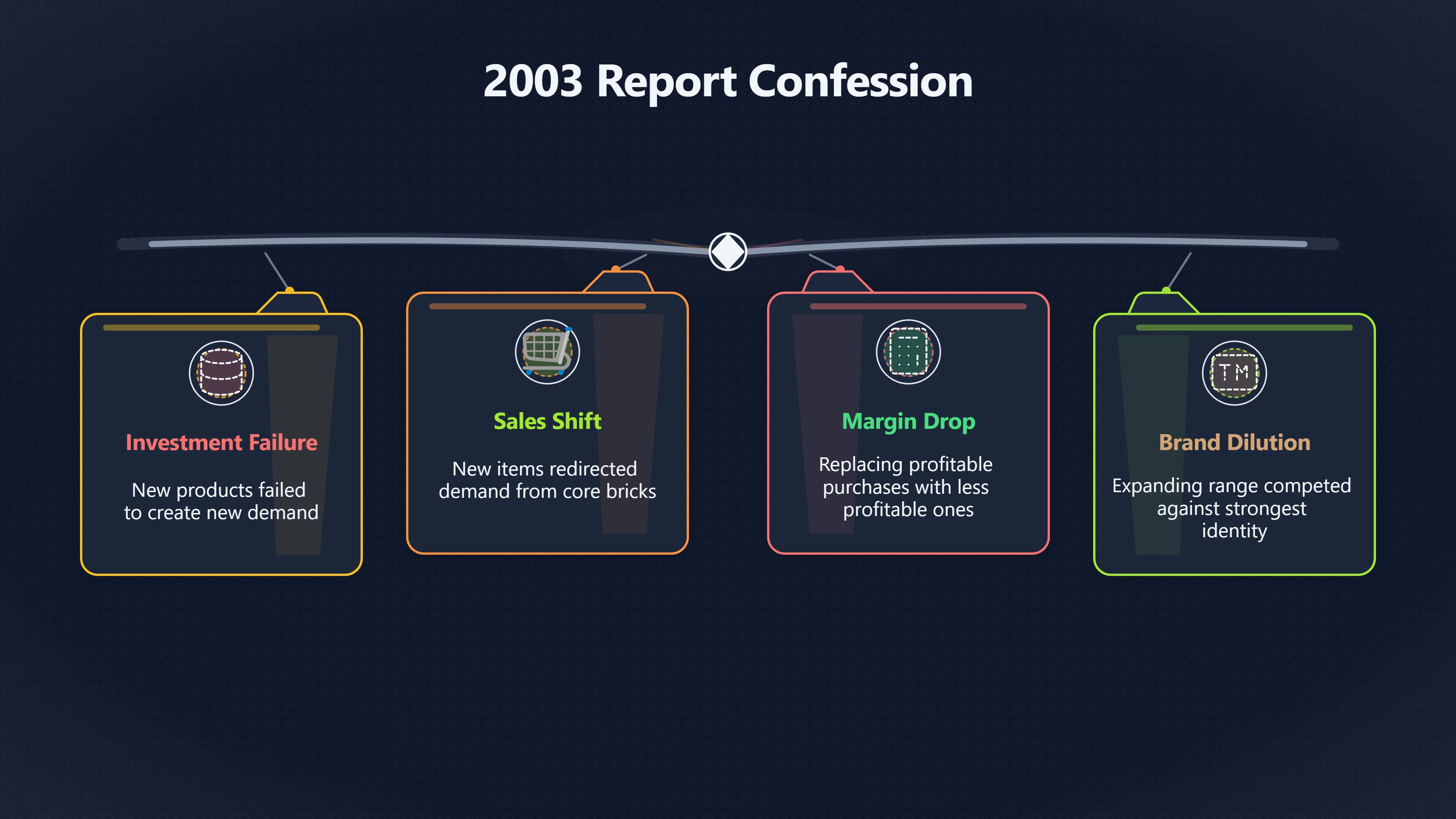
LEGO’s early-2000s crisis revealed a counterintuitive problem: some of the company’s new products were not creating new demand but redirecting demand away from the business that already worked. In its 2003 annual report, LEGO openly admitted that years of investment in expanding the product portfolio had failed to deliver the expected returns and that some new products had “cannibalised” sales from core LEGO products.[LEGO]lego.comAnnual Report 2003 LEGO CompanyMarch 10, 2004 — This commitment and the consequent cost increases have not produced the desired results…
 That admission matters because it exposed a specific form of fragility. The company had assumed that more themes, more formats and more branded experiences would create growth. Instead, parts of the expanding range competed against the brick system that generated the strongest margins, the clearest brand identity and the most reusable manufacturing assets. Rather than increasing resilience, product proliferation weakened LEGO’s centre of gravity.
When LEGO Admitted the Portfolio Was Hurting Itself
The most direct evidence comes from LEGO’s own reporting. In 2003, the company stated that it had invested substantial resources in broadening its product portfolio but that the associated costs had not produced the desired results. More significantly, management acknowledged that some new products had cannibalised sales from the company’s core offerings and reduced earnings.[LEGO]lego.comick sets and find the perfect gift for your kid…
This was not merely a warning about failed experiments. It was an admission that certain new products generated revenue at the expense of existing revenue. A child buying a new LEGO-branded product was not always adding to total demand. In some cases, that child was simply choosing a different LEGO product instead of a traditional brick-based set.
From an accounting perspective, sales might still appear healthy in individual categories. The deeper problem was economic. If a newer line carried higher development costs, required unique components or demanded separate marketing investment, replacing a profitable core purchase with a less profitable alternative could damage the company even when total unit sales appeared stable.
The 2003 report effectively challenged the assumption that every extension of the LEGO brand strengthened the business.[LEGO]lego.comOpen source on lego.com.
Why Internal Competition Mattered More Than External Competition
Most discussions of LEGO’s crisis focus on external threats such as video games, changing play habits or pressure from retailers. Those factors mattered, but LEGO’s own diagnosis pointed to another danger: internal competition.
The company was launching new concepts, themes and play systems at a pace that made it increasingly difficult to distinguish genuine growth from demand shifting within the portfolio. Instead of fighting only against competitors such as Mattel or Hasbro, LEGO products were increasingly competing against other LEGO products for the same household budget, shelf space and management attention.
Several mechanisms made this particularly damaging:
- Retail shelf displacement. New lines occupied store space that might otherwise have been devoted to proven brick-based products.
- Marketing dilution. Advertising budgets were spread across a growing number of concepts rather than reinforcing the strongest categories.
- Design resource diversion. Development teams spent time creating entirely new systems instead of improving successful core ranges.
- Operational complexity. New formats often required unique moulds, packaging and forecasting assumptions, increasing costs even when sales merely shifted internally.
The result was a portfolio that looked larger but was not necessarily generating proportionally more value. A successful new launch could still leave the company worse off if it displaced demand from a more profitable and scalable core product.
The DUPLO and LEGO Explore Lesson
One of the clearest examples was the decision to replace the established DUPLO brand with LEGO Explore in 2002.
Management hoped to create a broader developmental play system for younger children. On paper, the strategy appeared sensible. The company wanted a more modern framework that connected learning, play and early-childhood development. Consumers, however, did not respond as expected. The change weakened a trusted product identity and confused the market. Sales of preschool products fell sharply, with some accounts reporting a decline of roughly 37% during the period.[Hacerlo BIEN]hacerlobien.netHacerlo BIENLEGO Case Study 2014April 17, 2014 — June 2003, Jørgen Vig Knudstorp, then head of strategic development had pulled no…
The significance of the episode was not simply that LEGO Explore underperformed. The company had effectively disrupted a successful segment of its own business while trying to create a replacement. Instead of adding demand, the new concept weakened demand for an existing strength.
This illustrates the core logic of cannibalisation. Growth initiatives become dangerous when they erode a proven product franchise faster than they create new value.
Why Cannibalisation Was Especially Dangerous for LEGO
Cannibalisation affects many consumer companies, but LEGO faced unusual risks because of how its business model worked.
Historically, LEGO’s advantage came from a system rather than a single toy. Bricks were compatible across themes and generations. New sets strengthened the overall ecosystem because pieces could be reused and combined. This produced powerful economies of scale in manufacturing, design and customer loyalty.
Many of the newer initiatives of the late 1990s and early 2000s weakened those advantages.
As the company expanded into more specialised products, adjacent businesses and alternative play formats, it increased the number of unique components and operational requirements. At the same time, management struggled to understand which products were genuinely profitable. Later analyses of the crisis noted that the company lacked clear visibility into product-level economics and often did not know which offerings justified their development costs.[Scribd]scribd.comThe Turnaround of Lego Continued GrowthThe Turnaround of Lego Continued Growth | PDFLEGO's financial turnaround after 2003 was aided by strategic refocusing on core produ…
That meant cannibalisation could remain hidden. A new line might generate excitement and sales volume while quietly replacing purchases that previously came from a more profitable core category.
In antifragility terms, LEGO had reduced the strength of its most resilient asset: the brick system itself. Instead of allowing experimentation to reinforce the platform, parts of the portfolio began extracting value from it.

How Focus Changed the Portfolio Test
The turnaround under Jørgen Vig Knudstorp did not eliminate innovation. Instead, it changed the standard by which innovation was judged.
After the crisis, LEGO increasingly evaluated new products according to whether they strengthened the core building system and the brand’s central promise. Company strategy shifted toward classic product lines such as DUPLO, City, Technic and other brick-centred themes while reducing projects that were only loosely connected to the core business.[Studocu]studocu.comannual report 2004 legoThis means sharpened focus on such clas- sic product lines as LEGO DUPLO, LEGO Make…Read more…
This represented a different portfolio test.
Before the crisis, a proposed product often justified itself by the possibility of reaching a new market or creating a new revenue stream. After the crisis, a more important question emerged: would the product reinforce the LEGO system, or would it merely compete with it?
That distinction helped the company separate productive experimentation from self-destructive complexity. A new theme could still succeed if it increased engagement with the brick ecosystem. A product that weakened the ecosystem, even if it generated sales, became much harder to justify.
The lesson was not that cannibalisation is always bad. Some degree of self-competition is unavoidable in a creative consumer business. LEGO’s experience showed that cannibalisation becomes dangerous when management mistakes portfolio expansion for genuine growth and loses sight of which products create the company’s strongest economics.
What the Episode Revealed About Antifragility
The cannibalisation problem exposed a hidden weakness in LEGO’s pre-crisis strategy. The company believed that more variety automatically increased opportunity. In practice, excessive expansion made it harder to distinguish value creation from value redistribution.
An antifragile organisation benefits from experimentation because successful variations strengthen the system. LEGO discovered that experimentation can become fragile when new variations weaken the platform that supports them.
The 2003 admission remains one of the most revealing moments in the company’s history because it identified a failure that many growth strategies overlook. The danger was not simply that some new products failed. The danger was that some succeeded just enough to take demand away from the products that made LEGO strongest in the first place.[LEGO]lego.comnew sets and products레고® 신제품 | 최근 2개월 내 출시된 다양한 신상품 소개2026 신상품 레고® 시티 세트를 만나보세요. 컬렉션에 새롭게 추가된 멋진 차량과 건물, 놀라운 플레이 세트와 함께 상상하고, 조립하고, 즐거운 놀이를 시작해 보세요.Read more…
Amazon book picks
Further Reading
Books and field guides related to When More LEGO Products Hurt the Core. Use these as the next step if you want deeper reading beyond the article.
The Innovator's Dilemma: The Revolutionary Book That Will Cha...
Discusses tensions between new initiatives and core businesses.
Good Strategy, Bad Strategy
Explains focus and avoiding self-defeating diversification.

Brick by Brick: How LEGO Rewrote the Rules of Innovation and...
Covers the product-expansion mistakes that hurt LEGO's core business.
eBay marketplace picks
Marketplace Samples
Example marketplace items related to this page. Use the search link to explore similar finds on eBay.



Endnotes
1.
Source: lego.com
Link:https://www.lego.com/cdn/cs/aboutus/assets/blte6c97bc4718a1848/Annual_Report_2003_ENG.pdf
Source snippet
Annual Report 2003 LEGO CompanyMarch 10, 2004 — This commitment and the consequent cost increases have not produced the desired results...
Published: March 10, 2004
2.
Source: scribd.com
Title: The Turnaround of Lego Continued Growth
Link:https://www.scribd.com/document/730770212/The-Turnaround-of-Lego-Continued-Growth
Source snippet
The Turnaround of Lego Continued Growth | PDFLEGO's financial turnaround after 2003 was aided by strategic refocusing on core produ...
3.
Source: studocu.com
Title: annual report 2004 lego
Link:https://www.studocu.com/en-ca/document/laurentian-university/strategic-management/annual-report-2004-lego/40878675
Source snippet
This means sharpened focus on such clas- sic product lines as LEGO DUPLO, LEGO Make...Read more...
4.
Source: lego.com
Link:https://www.lego.com/en-us
Source snippet
ick sets and find the perfect gift for your kid...
5.
Source: lego.com
Link:https://www.lego.com/ko-kr
6.
Source: lego.com
Title: new sets and products
Link:https://www.lego.com/ko-kr/categories/new-sets-and-products
Source snippet
레고® 신제품 | 최근 2개월 내 출시된 다양한 신상품 소개2026 신상품 레고® 시티 세트를 만나보세요. 컬렉션에 새롭게 추가된 멋진 차량과 건물, 놀라운 플레이 세트와 함께 상상하고, 조립하고, 즐거운 놀이를 시작해 보세요.Read more...
7.
Source: studocu.com
Title: annual report 2003 lego company insights and developments
Link:https://www.studocu.com/bo/document/universidad-privada-franz-tamayo/proyecto-integrador-intermedio/annual-report-2003-lego-company-insights-and-developments/154762580
Source snippet
cannibalised on the sales of LEGO Company's core products and thus eroded earnings. Towards the end of the year, it...Read more...
8.
Source: studocu.com
Title: lego a navigating the crisis of 2004 and strategic turnaround
Link:https://www.studocu.com/row/document/tribhuvan-vishwavidalaya/business-economics/lego-a-navigating-the-crisis-of-2004-and-strategic-turnaround/135829963
Source snippet
LEGO (A): Navigating the Crisis of 2004 and Strategic...This case study examines the challenges faced by LEGO Group in 2004 under CEO Jø...
9.
Source: studocu.com
Link:https://www.studocu.com/en-us/document/brigham-young-university/case-studies/lego-case-study-navigating-strategic-challenges-bl0015/138205398
Source snippet
LEGO Case Study: Navigating Strategic Challenges...Jørgen Vig Knudstorp, who prevented the bankruptcy of the LEGO Group in 2004...
10.
Source: scribd.com
Title: Situation Analysis LEGOS
Link:https://www.scribd.com/document/552940938/Situation-Analysis-LEGOS
Source snippet
LEGO Market Analysis and Performance | PDF | InflationAn analysis of LEGO's financial data from 2000-2018 shows increasing revenue, profi...
11.
Source: secondactsbiz.substack.com
Link:https://secondactsbiz.substack.com/p/lego-the-turnaround
Source snippet
The Turnaround - Second ActsIn some cases, new products have even cannibalised the sales of LEGO Company's core products and thus eroded...
12.
Source: hacerlobien.net
Link:https://www.hacerlobien.net/lego/Grupol-012-Case-Study.pdf
Source snippet
Hacerlo BIENLEGO Case Study 2014April 17, 2014 — June 2003, Jørgen Vig Knudstorp, then head of strategic development had pulled no...
Published: April 17, 2014
13.
Source: Wikipedia
Link:https://en.wikipedia.org/wiki/Lego
Source snippet
LegoLego (/ˈlɛɡoʊ/, LEG-oh; Danish: [ˈle̝ːko]; stylised as LEGO) is a brand of plastic construction toys manufactured by the Lego Gr...
14.
Source: ciobusinessviews.com
Link:https://ciobusinessviews.com/case-study/detail/lego-how-data-driven-product-invention-resued-a-toy-giant-on-the-brink-of-bankruptcy
Source snippet
LEGO - How Data-Driven Product Invention Resued a Toy...This was followed by the turnaround that was made possible by first-time externa...
Additional References
15.
Source: medium.com
Link:https://medium.com/%40thedecisionmakersguide/blog-15-chapter-3-corporate-gems-how-lego-nearly-went-bankrupt-and-then-built-itself-back-57713f08fae4
Source snippet
Corporate Gems: How LEGO Nearly Went Bankrupt — and...LEGO's fall and rise prove that even the brink of failure can be the launchpad for...
16.
Source: instagram.com
Link:https://www.instagram.com/lego/?hl=en
Source snippet
LEGO (@lego) · BillundBuilding the future, one brick at a time. · A story of how a small town in Denmark became a giant landmark for play...
17.
Source: linkedin.com
Link:https://www.linkedin.com/posts/lindstromcompany_everyone-knows-lego-but-the-part-nobody-activity-7434606595847864320-udqi
Source snippet
LEGO's $800M Debt Crisis: How Focusing on the Core...Supply chains froze. Inventory stacked sky-high. Revenue came in but cash didn't. L...
18.
Source: linkedin.com
Link:https://www.linkedin.com/posts/jordan-saunders-b7073712_in-2004-lego-was-18-months-from-going-bankrupt-activity-7444752922002771968-U6r8
Source snippet
LEGO's 35-year-old savior cuts complexity, boosts profitsIn 2004, LEGO was 18 months from going bankrupt. $800 million in debt. Losing $1...
19.
Source: linkedin.com
Link:https://www.linkedin.com/posts/mikewwooten_lego-almost-went-bankrupt-in-2003-not-because-activity-7425596057906040832-doLC
Source snippet
Cutting Complexity: Lego's 30% Product Line ReductionIn 2003, the LEGO Group was on the brink of bankruptcy. Sales were collapsing. Costs...
20.
Source: youtube.com
Link:https://www.youtube.com/user/LEGO
Source snippet
LEGOLEGO® Gaming | LEGO · The best videos from the LEGO Gaming world! · LIVE LEGO FORTNITE! Mastering Fire & Flight in LEGO Fortnite Odys...
21.
Source: platform01consulting.com
Title: lego one of the greatest turnaround stories in corporate history
Link:https://platform01consulting.com/insights/lego-one-of-the-greatest-turnaround-stories-in-corporate-history
Source snippet
LEGO: One of the Greatest Turnaround Stories In...13 Aug 2023 — By the year 2003, Lego was encountering major difficulties.Sales had dec...
22.
Source: pressbooks.library.vcu.edu
Link:https://pressbooks.library.vcu.edu/businessfoundations201/chapter/14-8/
Source snippet
sales of LEGO Company's core products and thus eroded earnings” (LEGO Group...Read more...
23.
Source: markhub24.com
Title: lego strategic turnaround through innovation and focus
Link:https://www.markhub24.com/post/lego-strategic-turnaround-through-innovation-and-focus
Source snippet
LEGO: Strategic Turnaround Through Innovation and Focus15 Dec 2025 — LEGO Group faced near-bankruptcy in 2003–2004 after years of uncontr...
24.
Source: csmonitor.com
Title: Lego rebuilds its business model amid falling sales
Link:https://www.csmonitor.com/Business/2017/0905/Lego-rebuilds-its-business-model-amid-falling-sales
Source snippet
Joergen Vig Knudstorp. Revenue dropped 5 percent in the first six months of the year, to 14.9 billion kroner ($2.4 billion), mainly as a...
Topic Tree