Within LEGO Antifragility
When More LEGO Products Made LEGO Weaker
Too many parts, lines and adjacent activities made LEGO harder to run until the crisis forced simplification.
On this page
- How variety can turn into operational drag
- Why simplification mattered in the turnaround
- The balance between breadth and coherence
Page outline Jump by section
Introduction
LEGO’s early-2000s crisis was not only a story of weak sales, digital competition or failed side bets. A quieter fragility sat inside the product system itself: too much variety had made the company harder to run. New themes, specialised pieces, adjacent product lines and scattered development efforts created operational drag faster than they created customer value. By 2003, LEGO’s own annual report admitted that years of expanding the product portfolio had raised costs without producing the desired results, and that some new products had even cannibalised core LEGO sales.[LEGO]lego.comAnnual Report 2003 ENGAnnual Report 2003 ENG
In antifragility terms, the crisis exposed a hidden weakness. LEGO’s strength had always been combinability: many possible models from a disciplined system of compatible parts. But when variety lost that discipline, optionality became clutter. The turnaround mattered because it did not reject innovation; it forced LEGO to distinguish productive breadth from expensive incoherence.
How Variety Became Operational Drag
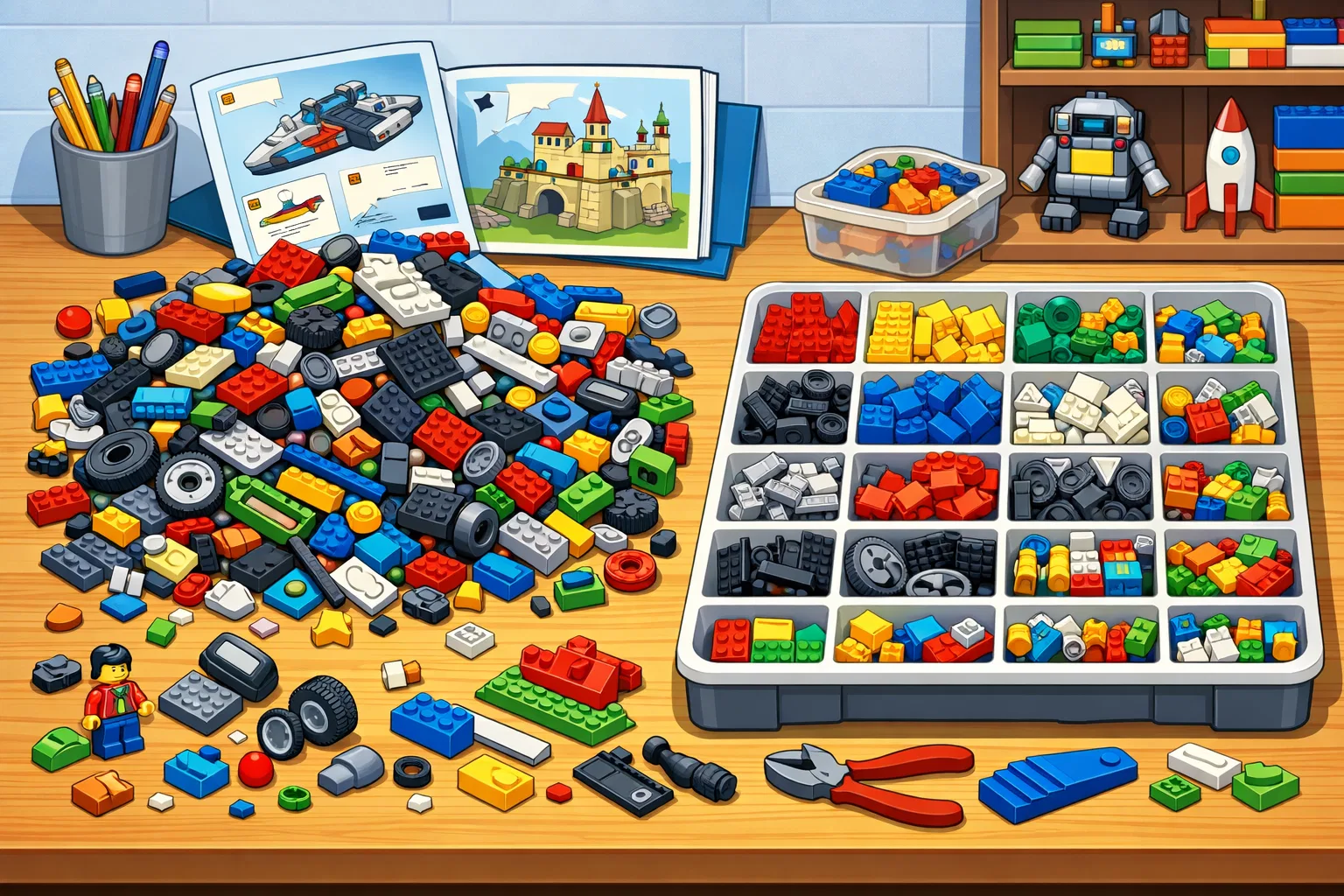
LEGO’s product appeal depends on variety. A child, adult fan or collector can move from a police station to a Technic car, a Star Wars ship, a botanical display model or a box of loose bricks and still recognise the same basic system. That breadth is valuable because every compatible element can, in principle, enrich the whole LEGO universe.
The fragility appeared when variety stopped reinforcing the system and began burdening it. During the years before the crisis, LEGO pursued a wide innovation agenda, including theme parks, craft sets, an action-figure line and other ventures that moved away from the repeatable economics of the brick. Harvard Business Review’s account of the turnaround notes that several of these efforts, including theme parks, Clikits and Galidor, were unprofitable or failed outright.[Harvard Business Review]hbr.orginnovating a turnaround at legoinnovating a turnaround at lego
The problem was not simply that some products failed. Every toy company has misses. The deeper issue was that complexity made failure more costly. Specialised elements, packaging variations, new materials, separate supply needs and unfamiliar retail propositions all increased the burden on design, manufacturing, forecasting and distribution. A failed theme made from standard bricks could still leave useful knowledge and reusable parts. A failed line built around non-standard assumptions could leave tooling, inventory and marketing costs that were harder to recover.
Strategy+Business described LEGO’s supply chain before the turnaround as outdated and misaligned with the needs of increasingly powerful retailers such as Wal-Mart and Carrefour. By the time Jørgen Vig Knudstorp became chief executive in 2004, the company was handling more than 10,000 permutations of products and hundreds of packaging configurations, while suffering poor customer service and inconsistent product availability.[Strategy]strategy-business.comStrategy+business Rebuilding Lego, Brick by BrickStrategy+business Rebuilding Lego, Brick by Brick[business]strategy-business.comStrategy+business Rebuilding Lego, Brick by BrickStrategy+business Rebuilding Lego, Brick by Brick
That is why product complexity was “hidden” fragility. On the shelf, a larger assortment could look like creativity. Inside the company, it could mean more moulds, longer changeovers, harder planning, more inventory risk, and less certainty about which products were actually profitable.

Why More Products Did Not Mean More Strength
The most revealing evidence comes from LEGO’s own 2003 reporting. The company stated that it had invested substantial funds in expanding its product portfolio, but that the resulting cost increases had not delivered the expected results. It also acknowledged that some new products had cannibalised sales from core LEGO products and eroded earnings.[LEGO]lego.comAnnual Report 2004 ENGAnnual Report 2004 ENG
That admission matters because it challenges a simple growth assumption: more products should mean more chances to win. In LEGO’s case, more products sometimes meant more internal competition. A new line could take attention, shelf space and spending away from the products that already carried the brand’s strongest economics.
The DUPLO reversal is a useful example. LEGO replaced the DUPLO brand with LEGO Explore in 2002, aiming to present a broader development system for pre-school children. The change failed to persuade consumers, and pre-school sales dropped sharply before the company recognised the mistake and brought back DUPLO as a clearer, trusted segment.[www.slideshare.net]slideshare.netthe lego case study the great turnaroundthe lego case study the great turnaround
That episode shows how complexity can weaken a brand even when the underlying intention is sensible. LEGO was not wrong to think about early-childhood development. It was wrong to make the product architecture and customer message less coherent. Parents did not necessarily want a more abstract developmental proposition; they recognised DUPLO as the larger-brick, younger-child gateway into the LEGO system.
Galidor showed the risk from a different angle. Released in 2002, it moved away from traditional LEGO bricks towards interchangeable action figures and was later discontinued. Its failure has often been cited as part of the pre-turnaround drift because it stretched LEGO into a format where compatibility with the brick system was weaker.[Wikipedia]WikipediaOpen source on wikipedia.org.
Both examples point to the same mechanism. Variety is valuable when it increases the usefulness of the system. It is dangerous when it multiplies choices, parts and messages without deepening the core experience.
Why Simplification Mattered in the Turnaround
The turnaround did not succeed because LEGO became small, cautious or nostalgic. It succeeded because simplification restored the conditions under which innovation could pay off.
In 2004, LEGO’s annual report described a sharper focus on classic lines such as LEGO DUPLO, LEGO Make & Create, LEGO City and LEGO Technic. It also stated that development projects not directly associated with the core business, such as electronic games, had been transferred to licensed partners.[LEGO]lego.comFINAL Annual Report 2023FINAL Annual Report 2023
This was a crucial distinction. LEGO did not conclude that electronic games, media or licences were irrelevant. It concluded that the company did not need to carry every activity internally. Some adjacencies could be better handled through partners, while LEGO concentrated on the product system where it had distinctive strengths.
The same report linked the turnaround to cost reduction and efficiency measures. LEGO moved from a DKK 1,061 million loss before special items, financial income, expenses and tax in 2003 to a DKK 103 million profit on that measure in 2004, helped by reducing activities and cutting costs by DKK 1,523 million, equivalent to 20 per cent compared with 2003.[LEGO]lego.comthe LEGO Group Annual Report 2024the LEGO Group Annual Report 2024
Simplification also improved responsiveness. The 2004 report described efforts to halve product-development time, reduce lead times and reduce inventories.[LEGO]lego.comlego group delivers record results in 2024lego group delivers record results in 2024 These are not glamorous changes, but they are central to antifragility. A company cannot learn well from market feedback if its operations are too slow, too tangled or too expensive to adjust.
In this sense, LEGO’s crisis created a useful form of pain. It forced the company to ask whether each product made the system stronger, whether customers understood it, whether retailers could sell it, and whether operations could support it profitably. Fragility became visible only when the accumulated cost of “more” became impossible to ignore.

The Antifragile Lesson: Constraints Can Create Better Options
A common misunderstanding of antifragility is that it rewards endless experimentation. LEGO’s case suggests a narrower and more useful lesson: systems become stronger when experimentation happens inside constraints that preserve learning and limit downside.
The brick system is a constraint, but it is not a creative prison. It defines the rules that let variety accumulate value. A new wheel, window, arch, minifigure accessory or Technic connector can be reused across sets and years. A licensed theme can bring in new fans while still teaching them the same building grammar. A fan-designed set can become a commercial product if it fits the standards of the wider system.
By contrast, pre-crisis complexity often created one-off bets. The company could spend heavily on a new line, but if that line did not connect well to the broader system, its failure did not leave as much reusable value behind. The downside was operationally heavy; the upside was uncertain.
Harvard Business School’s discussion of the LEGO case summarises the rescue in terms that fit this mechanism: controlling complexity, clarifying the core of the business and engaging the wider community helped save the company.[harvard]d3.harvard.eduthe lego success story getting everything to awesomethe lego success story getting everything to awesome Business School Library The point is not that LEGO stopped making new things. It became more disciplined about which new things deserved to enter the system.
That is the difference between fragile variety and antifragile variety:
- Fragile variety adds products that require separate processes, separate explanations and separate economics.
- Antifragile variety adds products that strengthen the shared system, generate learning and leave reusable assets even when individual launches disappoint.
- Fragile innovation treats every trend as a reason to stretch the brand.
- Antifragile innovation uses the core system as a filter for deciding which trends LEGO can absorb without losing coherence.
The Balance Between Breadth and Coherence
LEGO’s later success complicates any simplistic “cut everything” lesson. The modern company has a broad portfolio, including children’s play themes, adult display sets, licensed entertainment properties, robotics, education products and direct-to-consumer retail. In 2023, LEGO described its portfolio as its largest ever, with 47 per cent of products new that year.[LEGO]lego.comLEGO Group 2023 Financial HighlightsLEGO Group 2023 Financial Highlights In 2024, it reported record results while continuing to invest in sustainability, retail and digital initiatives.[LEGO]lego.comThe LEGO Group FY 2024 Financial HighlightsThe LEGO Group FY 2024 Financial Highlights
This breadth shows that the turnaround was not an argument against variety. It was an argument for governed variety. LEGO can sell a huge range of products because many of them still share the same underlying logic: compatible parts, recognisable building, clear themes and a brand promise tied to creativity through construction.
The risk, however, has not disappeared. A large portfolio always creates tension. Adult collectors want detailed models. Children need accessible play. Licensed sets can attract attention but may depend on external entertainment cycles. Sustainability efforts may require new materials and manufacturing changes. Retail expansion can strengthen the brand but also adds operational obligations. The old fragility can return if breadth again outruns coherence.
That is why product complexity remains one of the most important LEGO lessons for antifragility. The company became stronger not by avoiding shocks, but by letting a severe shock reveal where its own system had become overgrown. The crisis forced LEGO to cut distracting complexity, restore the brick as the organising principle, and rebuild a portfolio where new products had to justify their place in the whole.

Why This Hidden Fragility Still Matters
The memorable part of LEGO’s turnaround is often framed as “back to the brick”. That phrase is useful, but incomplete. The deeper lesson is “back to a system that can absorb variety without being overwhelmed by it”.
Product complexity made LEGO weaker because it disguised cost as creativity. Each new line could be defended as innovation, market expansion or brand building. But together they made the business harder to understand, harder to forecast and harder to run. When the company could no longer absorb the drag, the crisis imposed discipline.
For readers thinking about antifragility, LEGO shows that strength is not the same as having many options. Strength comes from having options that remain connected, reusable and learnable. LEGO’s best products add variety without breaking the system. Its weakest pre-crisis experiments added variety that the system had to carry as weight.
Amazon book picks
Further Reading
Books and field guides related to When More LEGO Products Made LEGO Weaker. Use these as the next step if you want deeper reading beyond the article.

Antifragile: Things That Gain from Disorder
Frames the relationship between complexity, resilience and fragility.

Brick by Brick: How LEGO Rewrote the Rules of Innovation and...
Directly examines excessive product complexity and simplification.
eBay marketplace picks
Marketplace Samples
Example marketplace items related to this page. Use the search link to explore similar finds on eBay.


Endnotes
1.
Source: lego.com
Title: Annual Report 2003 ENG
Link:https://www.lego.com/cdn/cs/aboutus/assets/blte6c97bc4718a1848/Annual_Report_2003_ENG.pdf
2.
Source: slideshare.net
Title: the lego case study the great turnaround 2003 2013
Link:https://www.slideshare.net/slideshow/the-lego-case-study-the-great-turnaround-2003-2013/33496623
3.
Source: Wikipedia
Link:https://en.wikipedia.org/wiki/Galidor
4.
Source: lego.com
Title: Annual Report 2004 ENG
Link:https://www.lego.com/cdn/cs/aboutus/assets/blt07abb4b8a3da3f39/Annual_Report_2004_ENG.pdf
5.
Source: lego.com
Title: FINAL Annual Report 2023
Link:https://www.lego.com/cdn/cs/aboutus/assets/blt7e9167f47da173a6/FINAL_Annual_Report_2023.pdf
6.
Source: lego.com
Title: the LEGO Group Annual Report 2024
Link:https://www.lego.com/cdn/cs/aboutus/assets/blt1cdf90a38318ef56/the_LEGO_Group_Annual_Report_2024.pdf
7.
Source: lego.com
Title: lego group delivers record results in 2024
Link:https://www.lego.com/en-us/aboutus/news/2025/march/lego-group-delivers-record-results-in-2024
8.
Source: lego.com
Title: LEGO Group 2023 Financial Highlights
Link:https://www.lego.com/cdn/cs/aboutus/assets/bltae284fd27d06ccb4/LEGO_Group_2023_Financial_Highlights.pdf
9.
Source: lego.com
Title: The LEGO Group FY 2024 Financial Highlights
Link:https://www.lego.com/cdn/cs/aboutus/assets/bltf2a6246ed68fd0b6/The_LEGO_Group_FY_2024_Financial_Highlights.pdf
10.
Source: lego.com
Link:https://www.lego.com/en-us/aboutus/lego-group/policies-and-reporting/reports
11.
Source: lego.com
Title: LEGO Group Sustainability Statement 2024
Link:https://www.lego.com/cdn/cs/aboutus/assets/blt2a759726033d5b67/LEGO_Group_Sustainability_Statement_2024.pdf
12.
Source: lego.com
Title: The LEGO Group FY 2024 Performance Highlights
Link:https://www.lego.com/cdn/cs/aboutus/assets/bltefaef83bc5bbde27/The_LEGO_Group_FY_2024_Performance_Highlights.pdf
13.
Source: lego.com
Link:https://www.lego.com/cdn/cs/aboutus/assets/blte543dd46714c9226/The_LEGO_Group_2025_Annual_Report.pdf
14.
Source: lego.com
Title: lego delivered topline growth and outpaced market in 2023
Link:https://www.lego.com/en-us/aboutus/news/2024/march/lego-delivered-topline-growth-and-outpaced-market-in-2023
15.
Source: d3.harvard.edu
Title: the lego success story getting everything to awesome
Link:https://d3.harvard.edu/platform-rctom/submission/the-lego-success-story-getting-everything-to-awesome/
16.
Source: d3.harvard.edu
Title: rebuilding lego
Link:https://d3.harvard.edu/platform-rctom/submission/rebuilding-lego/
17.
Source: Wikipedia
Title: Brick by Brick: How Lego Rewrote the Rules of Innovation
Link:https://en.wikipedia.org/wiki/Brick_by_Brick%3A_How_Lego_Rewrote_the_Rules_of_Innovation
18.
Source: hbr.org
Title: innovating a turnaround at lego
Link:https://hbr.org/2009/09/innovating-a-turnaround-at-lego
19.
Source: strategy-business.com
Title: Strategy+business Rebuilding Lego, Brick by Brick
Link:https://www.strategy-business.com/article/07306
20.
Source: library.hbs.edu
Title: Harvard Business School Library HBS Cases: LEGO | Working Knowledge
Link:https://www.library.hbs.edu/working-knowledge/hbs-cases-lego
21.
Source: strategyzer.com
Link:https://www.strategyzer.com/library/legos-great-business-model-turnaround-story
22.
Source: bigintblog.files.wordpress.com
Link:https://bigintblog.files.wordpress.com/2014/08/lego.pdf
23.
Source: facebook.com
Title: business turnaround lesson from legoin the early 2000s lego was in deep trouble
Link:https://www.facebook.com/darrenleejacklin/posts/-business-turnaround-lesson-from-legoin-the-early-2000s-lego-was-in-deep-trouble/10172441418155512/
24.
Source: strategosinstitute.com
Title: LEG O®
Link:https://www.strategosinstitute.com/uploads/cf17cf06ff987718f7a8d8edfb65bc2e6abe59cb33bfd8b079f41b20964e04af.pdf
Additional References
25.
Source: cfocentre.com
Link:https://www.cfocentre.com/sg/true-toy-story-legos-incredible-turnaround-tale-2/
26.
Source: amazon.nl
Link:https://www.amazon.nl/Brick-Rewrote-Innovation-Conquered-Industry/dp/0307951618
27.
Source: bonsite.nl
Link:https://bonsite.nl/phpcmsys/file/fosiroxem_lajed.pdf
28.
Source: linkedin.com
Link:https://www.linkedin.com/posts/caroline-king-mba_the-lego-group-nearly-collapsed-in-the-early-activity-7397009879326167040-2AMS
29.
Source: linkedin.com
Link:https://www.linkedin.com/posts/williamstern_back-in-the-early-2000s-lego-almost-collapsed-activity-7375197696992796672-Eq49
30.
Source: facebook.com
Link:https://www.facebook.com/SimonGerman600/posts/lego-revenue-in-recent-years-has-been-through-the-roof-the-turnaround-story-of-l/1254938805994825/
31.
Source: scribd.com
Link:https://www.scribd.com/document/844890827/Case-study
32.
Source: scribd.com
Link:https://www.scribd.com/document/730770212/The-Turnaround-of-Lego-Continued-Growth
33.
Source: michealhalpin.com
Link:https://michealhalpin.com/a-review-of-brick-by-brick-how-lego-rewrote-the-rules-of-innovation-and-conquered-the-global-toy-dbfd03d9eb40
34.
Source: linkedin.com
Link:https://www.linkedin.com/posts/alec-chapados-0b12b11b7_in-2003-the-lego-group-was-seconds-away-activity-7363343003370856448-RHig
Topic Tree
Follow this branch
Parent topic
LEGO AntifragilityRelated pages 14
- Adult Sets Why Adults Became Central to LEGO Growth
- Brick System Why the Brick Became LEGO's Best Constraint
- Crisis Test What LEGO's Crisis Revealed About Fragility
- Digital Play Can LEGO Adapt Without Losing the Brick?
- Failed Bets What LEGO's Failed Bets Taught the Company
- Fan Signals How LEGO Fans Became a Market Sensor
- Framework Is LEGO Really Antifragile or Just Resilient?
- Governed Bets How LEGO Learned To Make Safer Bets
- +6 more in sidebar
- Cannibalisation When More LEGO Products Hurt the Core
- Packaging Drag The Hidden Cost of Too Many Boxes
- Partner Shift Why LEGO Did Not Need to Do Everything
- Special Parts Why Some LEGO Failures Left More Waste
- The Short Lived Replacement Of DUPLO With LEGO Explore In The Early... Why Replacing DUPLO Made LEGO Less Clear