Within Failed Bets
Why Galidor Needed Too Many Things to Work
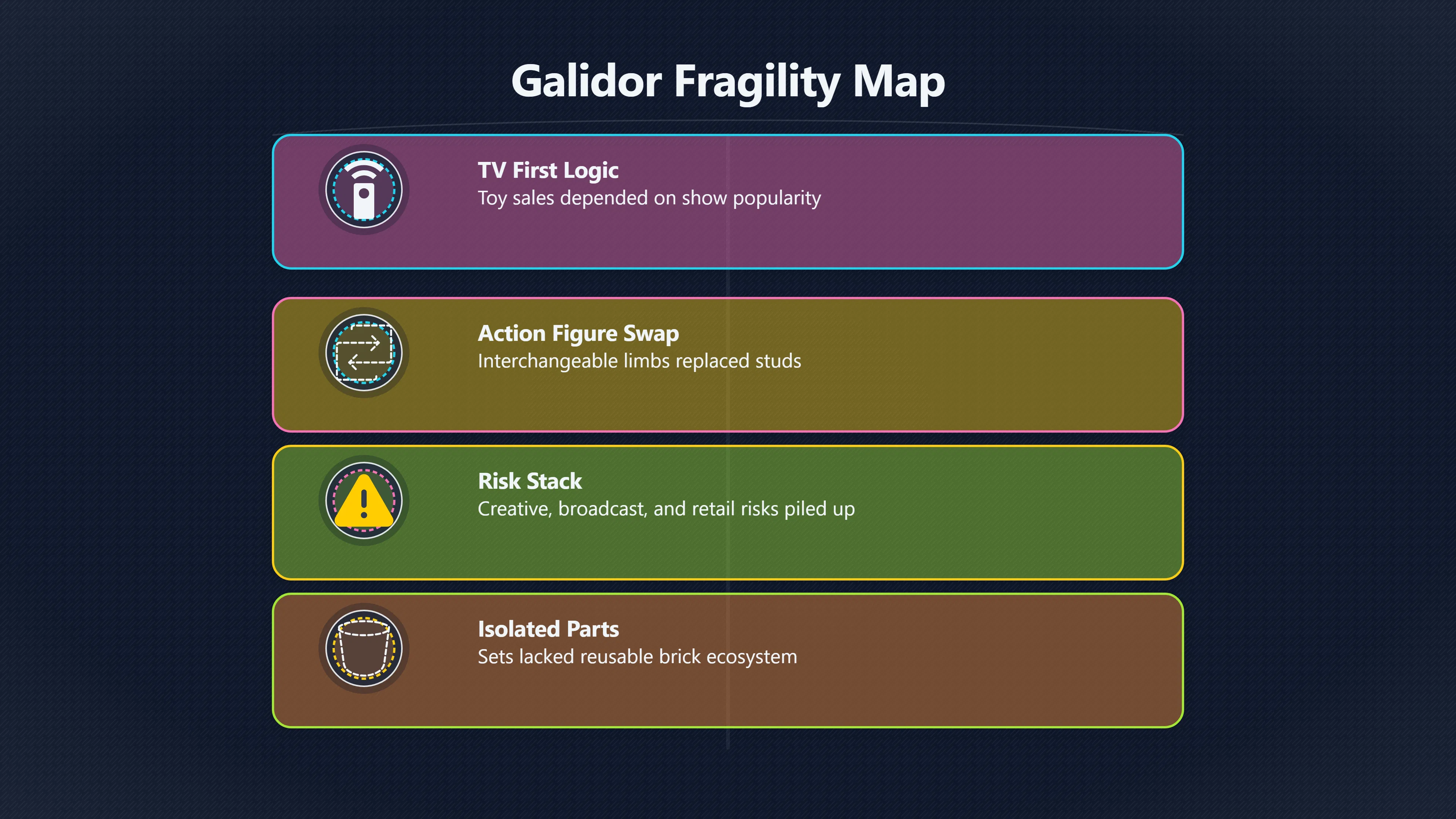
Galidor depended on television, characters and promotions working together, but the toys did not offer enough LEGO-style building depth.
On this page
- The television first launch logic
- Why action figures weakened the building loop
- How media dependence increased downside risk
Page outline Jump by section
Introduction
Galidor became one of LEGO’s clearest examples of fragile growth because the toy line depended on several outside systems succeeding at the same time. The company was not simply launching a new construction set. It was launching a television series, new characters, a merchandising strategy and an action-figure format that sat far from the traditional LEGO brick. When those pieces failed to reinforce one another, the entire project weakened. Later accounts of LEGO’s early-2000s crisis repeatedly grouped Galidor with other unsuccessful diversification efforts that pulled the company away from its strongest capabilities.[Harvard Business Review]hbr.orgHarvard Business ReviewInnovating a Turnaround at LEGOMany of its innovation efforts—theme parks, Clikits craft sets… Galidor supporte…
 In antifragility terms, Galidor was vulnerable because its success required coordinated execution across media, retail, storytelling and toy sales. Traditional LEGO themes could survive weak storytelling because the building system itself generated value. Galidor needed the television programme, characters and marketing campaign to carry much more of the load.
Why Galidor Needed Too Many Things to Work
The television-first launch logic
Galidor was designed during a period when LEGO was searching for growth beyond its classic construction-toy model. The company created a science-fiction property centred on interchangeable action figures and then commissioned a television series to establish the world, characters and narrative. The show premiered in 2002 on Fox Kids in the United States and YTV in Canada, with the toy line launched as part of the same broader franchise effort.[Wikipedia]WikipediaGalidor: Defenders of the Outer DimensionGalidor: Defenders of the Outer Dimension
This approach reflected a wider industry belief that successful children’s brands increasingly emerged from entertainment ecosystems rather than from toys alone. Instead of children discovering a toy and inventing stories around it, Galidor expected viewers to become invested in a television narrative and then buy products connected to that narrative.
The strategic problem was that this made toy demand dependent on media performance. If the programme failed to attract a large audience, toy sales suffered immediately. If broadcasters changed schedules, if marketing underperformed or if children did not connect with the characters, the physical product lost much of its appeal. Reports on the series later noted that LEGO believed the programme failed to reach the expected level of popularity in the United States and that publicity problems also hurt awareness.[Wikipedia]WikipediaGalidor: Defenders of the Outer DimensionGalidor: Defenders of the Outer Dimension
A conventional LEGO set did not face the same dependency chain. A Castle, City or Space set could succeed because the building experience itself generated play value. Galidor required attention first and construction second.
Why action figures weakened the building loop
The second source of fragility came from the toys themselves. Galidor figures featured interchangeable limbs and body parts, but they largely abandoned the familiar studs-and-tubes system that made LEGO products part of a wider construction ecosystem. LEGO later acknowledged that the line did not use the iconic brick connection system associated with the brand.[Internet Archive]archive.orgInternet ArchiveBits N' Bricks #37 - The Surreal History of the LEGO Galidor…3 Jun 2022 — How a LEGO game console, sci-fi TV show, and…
This mattered because LEGO’s strongest products historically benefited from a reinforcing play loop:
- A child builds something.
- The model can be rebuilt, modified or combined with other sets.
- Existing pieces remain useful for future creations.
- Every new purchase increases the value of the overall collection.
Galidor interrupted that cycle. Swapping limbs offered a form of customisation, but it was narrower than open-ended building. The figures behaved more like action figures with modular body parts than like components in a growing construction system. Critics and fans frequently described the line as feeling insufficiently “LEGO” because it lacked the depth and flexibility associated with brick-based play.[Brickset.com]brickset.comgalidor was it all badGalidor: was it all bad?2 Apr 2015 — The twenty Galidor sets LEGO produced in 2002, in case you need reminding, are generally considered…
From an antifragility perspective, this was crucial. Traditional LEGO products gain resilience because each set strengthens a larger network of compatible parts. Galidor products were comparatively isolated. A disappointing set generated less learning, less reuse and fewer opportunities for children to create value independently of the official story.
How Media Dependence Increased Downside Risk
Galidor’s design made failure more expensive than failure in a normal toy theme.
A standard LEGO theme could underperform and still leave behind reusable parts, design ideas, moulds or building techniques that benefited other product lines. Galidor required investment in television production, character development, licensing arrangements, promotion and specialised product design. Much of that investment only made sense if the franchise achieved significant audience traction.
The result was a stack of interlocking risks:
- Creative risk: children had to like the characters and story.
- Broadcast risk: networks had to deliver an audience.
- Marketing risk: consumers had to understand the new universe.
- Retail risk: shops had to support an unfamiliar product category.
- Toy-design risk: children had to accept a LEGO product that barely resembled traditional LEGO building.
If any one layer weakened, pressure spread through the rest of the system.
The problem became especially visible internationally. Retrospectives on Galidor have noted that broadcasting and promotional complications reduced the synchronisation between television exposure and toy availability in some markets. When the media engine and retail engine stopped moving together, the franchise lost momentum.[Brickset.com]brickset.comlego fails galidorLEGO Fails: Galidor10 Dec 2016 — Another big failure of Galidor was failing to adequately account for UK broadcasting laws, which prohibi…
This is the opposite of an antifragile structure. Antifragile systems benefit from small failures because the failures generate feedback without threatening the whole system. Galidor concentrated risk instead. Weak television performance did not merely damage the show; it damaged toy demand, retailer confidence and the broader franchise strategy simultaneously.

The Difference Between Bionicle and Galidor
The contrast with Bionicle helps explain why Galidor’s media bet proved so fragile.
Both lines used storytelling. Both sought to create characters and fictional worlds. Both attempted to engage children through narrative rather than through construction alone.
The difference was that Bionicle still reinforced LEGO’s core strengths. Its mythology encouraged collecting, building and combining parts. Even when children cared deeply about the story, the products remained rooted in a system of construction play. Storytelling amplified the toy rather than replacing its primary source of value.
Galidor moved closer to the logic of a media franchise that happened to sell toys. The television series became a prerequisite for understanding the product, and the product itself offered less of the open-ended building experience that traditionally compensated for weaknesses in narrative or marketing.
That distinction became important in LEGO’s later recovery. The company did not abandon storytelling after Galidor. Instead, it became more selective about ensuring that stories strengthened the building system rather than substituting for it. Later successes such as Ninjago used television and character narratives to support construction play, not to replace it. The lesson was not that media was dangerous. The lesson was that media became fragile when it carried more value than the toy itself.
What Galidor Revealed About LEGO’s Crisis
Galidor exposed a broader misunderstanding that existed inside LEGO before its turnaround. Management was searching for growth through entertainment, licensing and lifestyle expansion, but some experiments weakened the connection between innovation and the company’s core system.
Harvard Business Review’s account of LEGO’s recovery later cited Galidor as one of several innovation efforts that were unprofitable or failed outright.[Harvard Business Review]hbr.orgHarvard Business ReviewInnovating a Turnaround at LEGOMany of its innovation efforts—theme parks, Clikits craft sets… Galidor supporte…
The deeper problem was not that LEGO invested in television. The company would later use films, games and television very successfully. The problem was that Galidor relied on external attention more than on the self-reinforcing qualities of the LEGO building experience.
An antifragile LEGO product becomes stronger as children modify it, combine it with other sets and extend it beyond the original design. Galidor depended on viewers continuing to watch, broadcasters continuing to support the programme and the franchise continuing to generate excitement. That made it vulnerable to shocks originating far outside the toy box.
For LEGO’s later leadership, Galidor became a cautionary example of expansion that increased dependence instead of resilience. Rather than creating another pathway back into the brick system, it created a chain of requirements in which too many things had to succeed simultaneously. When the chain broke, there was very little underneath it to absorb the failure.
Amazon book picks
Further Reading
Books and field guides related to Why Galidor Needed Too Many Things to Work. Use these as the next step if you want deeper reading beyond the article.
The Innovator's Dilemma
Useful framework for understanding complex product ecosystem failures.


Brick by brick
Explores multi‑channel risks and strategic missteps relevant to Galidor.
The Secret Life of Lego Bricks: The Inside Story of a Design...
Contextualises LEGO product design and brand evolution.
eBay marketplace picks
Marketplace Samples
Topic-anchored marketplace searches for visual, collectible, or second-hand items related to this page.




Endnotes
1.
Source: Wikipedia
Title: Galidor: Defenders of the Outer Dimension
Link:https://en.wikipedia.org/wiki/Galidor%3A_Defenders_of_the_Outer_Dimension
2.
Source: archive.org
Link:https://archive.org/details/LEGOBitsNBricks-s03e37
Source snippet
Internet ArchiveBits N' Bricks #37 - The Surreal History of the LEGO Galidor...3 Jun 2022 — How a LEGO game console, sci-fi TV show, and...
3.
Source: brickset.com
Title: galidor was it all bad
Link:https://brickset.com/article/14936/galidor-was-it-all-bad
Source snippet
Galidor: was it all bad?2 Apr 2015 — The twenty Galidor sets LEGO produced in 2002, in case you need reminding, are generally considered...
4.
Source: brickset.com
Title: lego fails galidor
Link:https://brickset.com/article/25231/lego-fails-galidor
Source snippet
LEGO Fails: Galidor10 Dec 2016 — Another big failure of Galidor was failing to adequately account for UK broadcasting laws, which prohibi...
5.
Source: brickset.com
Title: galidor yes it was all bad
Link:https://brickset.com/article/14947/galidor-yes-it-was-all-bad
Source snippet
Galidor: yes it was all bad3 Apr 2015 — This has to be the worst LEGO set I've ever built: no instructions, legs and arms sprouting out a...
6.
Source: d3.harvard.edu
Link:https://d3.harvard.edu/platform-rctom/submission/the-lego-success-story-getting-everything-to-awesome/
Source snippet
LEGO Success Story: Getting Everything to Awesome!28 Nov 2015 — Lesson learned: focus on core competencies, and do not be afraid to shut...
7.
Source: d3.harvard.edu
Title: rebuilding lego
Link:https://d3.harvard.edu/platform-rctom/submission/rebuilding-lego/
Source snippet
(5)David Robertson, “Innovating a Turnaround at LEGO,”...Read more...
8.
Source: hbr.org
Link:https://hbr.org/2009/09/innovating-a-turnaround-at-lego
Source snippet
Harvard Business ReviewInnovating a Turnaround at LEGOMany of its innovation efforts—theme parks, Clikits craft sets... Galidor supporte...
9.
Source: youtube.com
Link:https://www.youtube.com/watch?v=IZ9ArQSpofM
Source snippet
The Turnaround of LEGO | From Losing $1 Million Per Day To...In 2003, LEGO was losing a million dollars a day. The company was $800 mill...
Additional References
10.
Source: linkedin.com
Link:https://www.linkedin.com/posts/supaste_lego-nearly-went-bankrupt-in-the-early-2000s-activity-7429795902984294400-qC7_
Source snippet
LEGO's Near Bankruptcy: Simplifying to SurviveThe turnaround came from an unexpected move: they cut products, not people. Fewer bricks. F...
11.
Source: linkedin.com
Link:https://www.linkedin.com/posts/everyonecaninnovate_afol-legoseriouslpay-lego-activity-7422382077158834177-bi9I
Source snippet
LEGO's Turnaround: Innovation Lessons from Near-...LEGO® was losing ~$1M a day—and nearly collapsed. What they did next became a masterc...
12.
Source: reddit.com
Link:https://www.reddit.com/r/lego/comments/wck4ie/lego_galidor_the_toy_that_almost_bankrupted_lego/
Source snippet
Lego Galidor: The Toy that Almost Bankrupted Lego: r/legoGalidor centered around a 15-year-old boy named Nick Bluetooth who utilized int...
13.
Source: designnews.com
Link:https://www.designnews.com/design-engineering/legos-unconventional-ventures-from-galidor-to-brittle-bricks-engineering-missteps
Source snippet
LEGO's Odd Ventures & Mishaps16 Jul 2025 — Nice-try failures. Galidor (2002). Perhaps LEGO's most infamous failure, Galidor was launched...
14.
Source: pinterest.com
Title: why [sustainability]({{ ‘sustainability/’ | relative_url }}) is now the key driver of innovation 185984659607539299
Link:https://www.pinterest.com/pin/why-sustainability-is-now-the-key-driver-of-innovation–185984659607539299/
Source snippet
Innovating a Turnaround at LEGO31 Aug 2009 —... Galidor supported by a television show—were unprofitable or had failed outright. Today...
15.
Source: hbr.org
Title: innovation under constraint constructing a turnaround at lego
Link:https://hbr.org/podcast/2016/10/innovation-under-constraint-constructing-a-turnaround-at-lego
Source snippet
Innovation Under Constraint: Constructing a Turnaround at...4 Oct 2016 — Harvard Business School professor Jan Rivkin takes listeners be...
16.
Source: theguardian.com
Title: how lego clicked the super brand that reinvented itself
Link:https://www.theguardian.com/lifeandstyle/2017/jun/04/how-lego-clicked-the-super-brand-that-reinvented-itself
Source snippet
How Lego clicked: the super brand that reinvented itself4 Jun 2017 — A book devoted to the subject, David Robertson's Brick by Brick: How...
17.
Source: markhub24.com
Title: lego strategic turnaround through innovation and focus
Link:https://www.markhub24.com/post/lego-strategic-turnaround-through-innovation-and-focus
Source snippet
LEGO: Strategic Turnaround Through Innovation and Focus15 Dec 2025 — The company achieved a strategic turnaround by refocusing on its cor...
18.
Source: helpmegrow.co.uk
Title: the lego turnaround a masterclass in business revival
Link:https://helpmegrow.co.uk/the-lego-turnaround-a-masterclass-in-business-revival/
Source snippet
The LEGO Turnaround: A Masterclass in Business Revival11 Dec 2024 — From crisis to triumph: LEGO's business transformation - Learn how st...
19.
Source: reddit.com
Link:https://www.reddit.com/r/lego/comments/1ngozk2/do_you_think_lego_would_have_gone_out_of_business/
Source snippet
idor if their name was instead "LEZJO" which would have had slightly...Read more...
Topic Tree