Within LEGO Antifragility
How LEGO Learned To Make Safer Bets
LEGO's stronger model came from experimenting with clearer rules, smaller losses and better links to the core business.
On this page
- Why random creativity became costly
- How governance channels experimentation
- What contained failure looks like
Page outline Jump by section
Introduction
LEGO did not become stronger after its early-2000s crisis by becoming more adventurous in every direction. It became stronger by learning how to govern adventure. Before the turnaround, the company had treated creativity almost as a licence to expand: theme parks, Clikits craft sets, Galidor, digital experiments and operational sprawl all promised growth, but many sat too far from the brick system or carried losses the core business could not absorb. Harvard Business Review’s account of the turnaround names theme parks, Clikits and Galidor among the unprofitable or failed innovation efforts that preceded the recovery.[Harvard Business Review]hbr.orginnovating a turnaround at legoinnovating a turnaround at lego
The post-crisis lesson was not “stop experimenting”. It was “make experiments answerable”. LEGO’s more antifragile model came from clearer rules, smaller and more visible losses, stronger links to the core business, and cross-functional governance that forced ideas to prove how they strengthened the wider system. In practice, safer bets meant ideas could still be new, digital, licensed, community-led or operationally complex, but they had to connect back to LEGO’s distinctive assets: the brick, the modular building system, the brand, fan communities, retailers and repeatable design processes.
Why Random Creativity Became Costly
The painful part of LEGO’s pre-turnaround story is that the company was not lazy or unimaginative. It was the opposite: it was innovating too widely, with too little discipline over fit, cost and execution. In antifragility terms, LEGO was exposed to volatility without enough containment. Each ambitious new venture could add complexity, but the organisation had not built a reliable way to make mistakes small, comparable and reusable.
The 2004 annual report makes the governance problem visible in financial language. LEGO’s Action Plan was built around setting a clearer direction, restoring competitiveness by focusing on customers and reducing risk by right-sizing activities, costs and assets. It also decided to sell the LEGOLAND Parks to improve liquidity and create a more solid financial base. Production and operating costs in the play materials business were cut by DKK 1,523 million, a 20 per cent reduction from the 2003 level, and the workforce was reduced by about 1,000 people.[LEGO]lego.comAnnual Report 2004 ENGAnnual Report 2004 ENG
That is not just a cost-cutting story. It shows that LEGO’s failed experiments had become entangled with the whole company’s risk profile. When innovation is poorly governed, failure does not stay inside the experiment. It spills into inventory, tooling, manufacturing complexity, retailer relationships, management attention and capital structure. A toy line that misses the market can be discontinued; a company-wide habit of unfocused expansion can threaten independence.
Galidor is the clearest symbolic example because it stretched LEGO towards an action-figure and media model that did not reinforce the classic construction system strongly enough. Clikits tried to reach girls through craft-like products, but LEGO’s own 2005 annual report later noted that the girls’ products Clikits line declined in sales despite “intense efforts” in 2004, and that no new Clikits products would be launched after 2006.[LEGO]lego.comAnnual Report 2005 ENGAnnual Report 2005 ENG These were not simply bad ideas in isolation. They were signs that creativity had outrun the company’s ability to ask, early enough, whether a bet made LEGO more LEGO.
How Governance Channels Experimentation
The strongest post-crisis change was the move from scattered innovation to coordinated innovation. Harvard Business Review describes a new cross-functional Executive Innovation Governance Group as central to the turnaround. Its role was to coordinate innovation activities strategically, define the new-product portfolio, allocate resources, delegate authority and evaluate results so that innovation supported company strategy rather than competing with it.[designblog.uniandes.edu.co]designblog.uniandes.edu.coharvardbusinessreview legoharvardbusinessreview lego
That governance mattered because LEGO’s innovation was not limited to new sets. The company treated innovation as a wider system involving product design, pricing, community building, business processes and channels to market. The point was to stop judging ideas only by their novelty and start judging them by their contribution to the whole business model.[designblog.uniandes.edu.co]designblog.uniandes.edu.coharvardbusinessreview legoharvardbusinessreview lego
The structure also made innovation more legible. LEGO divided responsibility across functional groups, the Concept Lab, Product and Marketing Development, and Community, Education and Direct activities. Each area had different expectations for how radical or incremental its innovation should be. Functional teams were expected to improve core and enabling processes; the Concept Lab explored new play experiences; product and marketing teams refreshed existing lines; community-facing teams connected with fans, education and direct channels.[designblog.uniandes.edu.co]designblog.uniandes.edu.coharvardbusinessreview legoharvardbusinessreview lego
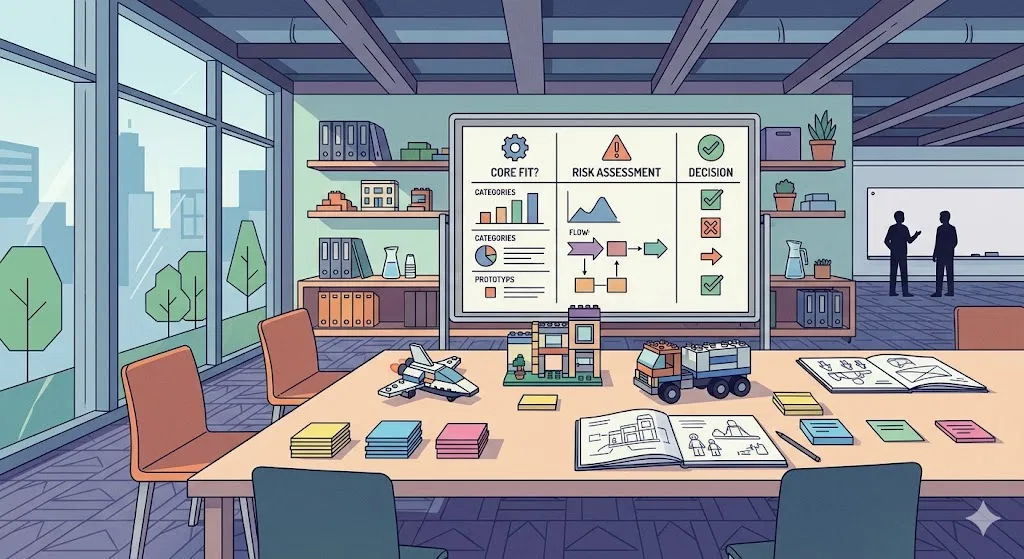
This is the governance move that turns volatility into learning. Instead of every new idea becoming a heroic exception, ideas entered a system that asked practical questions:
- Where does this fit? Is it a core product improvement, a new play category, a community experiment, a business-model test or an operational improvement?
- Who owns the risk? Which team is accountable for the result, and which other teams must support it?
- What does it strengthen? Does it improve the brick system, customer profitability, fan engagement, retailer economics, manufacturing capability or brand relevance?
- How will failure be read? Can LEGO learn from the result without letting one miss damage the whole company?
This is why governance did not make LEGO less creative. It gave creativity a track to run on.
What Contained Failure Looks Like
Contained failure is not failure made painless. It is failure that is bounded, interpretable and useful. LEGO’s post-crisis experiments still sometimes missed, but the company became better at making those misses survivable and instructive.
One example is LEGO Games, the buildable board-game line launched first in the UK and Germany in 2009 and planned for wider release in 2010. HBR presented it as a governed innovation case: the Concept Lab developed the new category using input from customer communities, manufacturing teams handled new component requirements, and community channels supported launch and engagement.[designblog.uniandes.edu.co]designblog.uniandes.edu.coharvardbusinessreview legoharvardbusinessreview lego The line did not become a permanent pillar on the scale of City, Star Wars or Technic, but its logic was safer than earlier scattershot bets. It used classic bricks, kept building at the centre, tested a new family play occasion and distributed responsibility across the organisation.
LEGO Universe shows the harsher side of contained failure. The online game was a large and expensive digital bet, later described in LEGO’s own Bits N’ Bricks material as costing more than $125 million, involving more than 450 contributors and stakeholders, and closing less than two years after launch. The same LEGO source argues that the project still taught the company important lessons about online play, infrastructure, child-safety systems and the need to “nail it before you scale it”.[LEGO]lego.combits n bricks s01e11 lego universe part 1 feature and transcriptbits n bricks s01e11 lego universe part 1 feature and transcript
That example complicates any simple claim that LEGO became perfectly antifragile. LEGO Universe was not a tiny loss. It was a major digital failure. But compared with the pre-crisis period, its lessons were more explicit: LEGO could see the cost of operating child-safe online worlds, the difficulty of aligning internal brand owners with external game developers, and the danger of scaling before the product and revenue model were proven. Game Informer reported LEGO’s explanation at closure: the game had positive feedback and almost two million players, but it had not built a satisfactory revenue model in its target group.[Game Informer]gameinformer.comlego universe closing in 2012.aspxlego universe closing in 2012.aspx
The difference is important. A fragile innovation system hides failure until it becomes existential. A governed innovation system surfaces failure as a decision point. LEGO Universe still hurt, but it did not pull LEGO away from its broader recovery; it became part of the company’s longer education in digital play.
The Core Became a Filter, Not a Cage
The post-turnaround LEGO model worked because governance was not merely financial policing. It was strategic filtering. The company did not ban licences, digital play, fan involvement or new audiences. It asked whether those moves reinforced the core system.
The 2005 annual report shows this distinction clearly. LEGO Star Wars products were among the company’s biggest-selling lines in 2005, and the Star Wars computer game sold more than three million copies and entered the top 10 in the United States. Crucially, the report says the game was launched with an external partner “in accordance with the LEGO Group’s strategy of focusing on core products”.[LEGO]lego.comHelp TopicsHelp Topics LEGO was still entering digital entertainment, but it was doing so through partnership rather than trying to own every capability itself.
That same report describes a more disciplined operating model: component counts were reduced, profitability calculations for customers and products were improved, production planning became more precise, and product development time was reduced, in some cases halved. It also says the portfolio moved towards a better balance between classic lines and more fad-driven products.[LEGO]lego.comAnnual Report 2008 ENGAnnual Report 2008 ENG These changes made experimentation less dangerous because LEGO could make, test, sell and stop products with a clearer view of cost and demand.
LEGO Ideas later institutionalised a similar principle for fan creativity. Reaching 10,000 supporters is a major milestone, but it does not automatically produce a set; LEGO then conducts a review, requests detailed model information and legal documents, and may choose the idea for production.[LEGO]lego.comOpen source on lego.com. The crowd can surface options, but LEGO retains a governance gate. That gate protects brand fit, manufacturability, licensing feasibility, safety and commercial viability.
This is one of the most useful lessons from LEGO’s antifragility story: constraints can make experimentation more productive. The brick system did not prevent novelty. It made novelty cumulative. A new set could add parts knowledge, building techniques, fan data, retailer insight and design capability even if the specific theme did not last forever.
Safer Bets Still Need Real Stakes
Governed innovation can be misunderstood as cautious bureaucracy. In LEGO’s case, it was closer to disciplined risk-taking. The company still had to make real bets: licensed themes, adult display models, robotics, fan-designed sets, digital games, app-linked play and new retail experiences. The difference was that those bets were increasingly judged by how they strengthened LEGO’s operating system.
This matters for antifragility because a company cannot benefit from disorder if every surprise is either ignored or allowed to become catastrophic. LEGO’s governance created a middle path. Market changes, fan behaviour, digital habits and product misses could generate information without forcing the company to reinvent itself from scratch each time.
The strongest policy intervention was therefore not a single committee, a single matrix or a single product rule. It was the combination of all three: strategic direction from the top, accountable ownership across functions, portfolio discipline, customer and product profitability measures, and a renewed insistence that experiments should connect to LEGO’s distinctive system. The company’s 2004 and 2005 reports show the reset from survival to process reform; HBR’s account shows the innovation governance structure that made experimentation more deliberate; later cases such as LEGO Games, LEGO Ideas and LEGO Universe show how the company kept learning from bets that were ambitious but increasingly easier to interpret. LEGO 4LEGO[4designblog.uniandes.edu.co]designblog.uniandes.edu.coharvardbusinessreview legoharvardbusinessreview lego
The Antifragile Lesson
LEGO’s governed innovation model is antifragile in a specific, limited sense. It does not mean every experiment succeeds, or that LEGO is immune to bad bets. It means the company became better at turning failed experiments into rules, filters and capabilities that improved the next round of experimentation.
Before the turnaround, creativity often expanded LEGO’s exposure. After the turnaround, governance helped convert creativity into options. A new idea had to pass through questions of strategic fit, customer value, profitability, operational feasibility and connection to the brick system. Failure could still happen, but it was more likely to be contained in a product line, a channel, a partnership or a stage gate rather than spread across the whole company.
That is why “safer bets” is the right phrase. LEGO did not make innovation safe by removing risk. It made risk safer by making it smaller, clearer, better owned and more closely tied to the core business. For a company built on recombination, the deeper recovery was not just financial. It was organisational: LEGO learned how to experiment in ways that made the system stronger, even when individual experiments did not last.
Amazon book picks
Further Reading
Books and field guides related to How LEGO Learned To Make Safer Bets. Use these as the next step if you want deeper reading beyond the article.
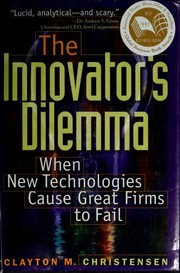
The Innovator's Dilemma: The Revolutionary Book That Will Cha...
Explores strategic innovation choices and organizational discipline.
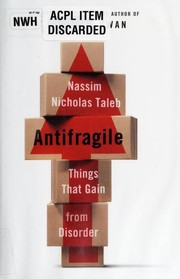
Antifragile: Things That Gain from Disorder
Supports the diversification argument behind decor-driven growth.

Brick by Brick: How LEGO Rewrote the Rules of Innovation and...
Directly covers the governance and innovation lessons discussed.
eBay marketplace picks
Marketplace Samples
Example marketplace items related to this page. Use the search link to explore similar finds on eBay.


Endnotes
1.
Source: hbr.org
Title: innovating a turnaround at lego
Link:https://hbr.org/2009/09/innovating-a-turnaround-at-lego
2.
Source: designblog.uniandes.edu.co
Title: harvardbusinessreview lego
Link:https://designblog.uniandes.edu.co/blogs/dise2102pc/files/2013/08/harvardbusinessreview_lego.pdf
3.
Source: lego.com
Title: Annual Report 2004 ENG
Link:https://www.lego.com/cdn/cs/aboutus/assets/blt07abb4b8a3da3f39/Annual_Report_2004_ENG.pdf
4.
Source: lego.com
Title: Annual Report 2005 ENG
Link:https://www.lego.com/cdn/cs/aboutus/assets/blt6eacf5a8b7af1359/Annual_Report_2005_ENG.pdf
5.
Source: lego.com
Title: bits n bricks s01e11 lego universe part 1 feature and transcript
Link:https://www.lego.com/cdn/cs/set/assets/blt73b64af9a0b918a8/bits_n_bricks_s01e11_lego_universe_part_1_feature_and_transcript.pdf
6.
Source: lego.com
Title: Help Topics
Link:https://www.lego.com/en-us/service/help-topics/article/what-happens-to-my-product-idea-after-i-reach-10-000-supporters
7.
Source: lego.com
Title: Annual Report 2008 ENG
Link:https://www.lego.com/cdn/cs/aboutus/assets/blt9ac392a2506c758a/Annual_Report_2008_ENG.pdf
8.
Source: lego.com
Link:https://www.lego.com/cdn/cs/aboutus/assets/blt4ee78e0776fce92f/LEGO_Company_Profile.pdf
9.
Source: lego.com
Title: Progress report2008
Link:https://www.lego.com/cdn/cs/aboutus/assets/bltfd7e22032c338c39/Progress_report2008.pdf
10.
Source: lego.com
Title: Annual Report 2010 ENG
Link:https://www.lego.com/cdn/cs/aboutus/assets/blt2369f169a1767fe2/Annual_Report_2010_ENG.pdf
11.
Source: hbr.org
Title: innovation under constraint constructing a turnaround at lego
Link:https://hbr.org/podcast/2016/10/innovation-under-constraint-constructing-a-turnaround-at-lego
12.
Source: hbr.org
Title: turn your customers into your community
Link:https://hbr.org/2020/01/turn-your-customers-into-your-community
13.
Source: hbr.org
Title: what companies that excel at strategic foresight do differently
Link:https://hbr.org/2026/01/what-companies-that-excel-at-strategic-foresight-do-differently
14.
Source: hbr.org
Link:https://hbr.org/2021/07/dont-buy-the-wrong-marketing-tech
15.
Source: store.hbr.org
Title: case studies
Link:https://store.hbr.org/case-studies/?p=62&page=54&price_max=24&price_min=16&srsltid=AfmBOoqikXJr8AGJE7Df8DXRw0PHZ-oP9rLSlXQeSEVwN7iIht7jI0ZQ
16.
Source: store.hbr.org
Title: case studies
Link:https://store.hbr.org/case-studies/?p=62&page=104&price_max=8&price_min=0&srsltid=AfmBOorztmCEvkp3it4HFyAx-AMCgKTepd7kvenmDGdvWmEH_U15vKKS
17.
Source: store.hbr.org
Title: case studies
Link:https://store.hbr.org/case-studies/?p=62&page=149&sessionGUID=070c24dd-ab35-b349-5414-1bb74c3ce51e&srsltid=AfmBOor6nx2tK1Qpb8z3MpmeaeHbppEkYTWBtTsRh0R2fS3jiQA8cM1s&webSyncID=c5ca2e99-a64e-1266-d75a-301398293ce1
18.
Source: d3.harvard.edu
Title: the lego success story getting everything to awesome
Link:https://d3.harvard.edu/platform-rctom/submission/the-lego-success-story-getting-everything-to-awesome/
19.
Source: d3.harvard.edu
Title: rebuilding lego
Link:https://d3.harvard.edu/platform-rctom/submission/rebuilding-lego/
20.
Source: hbsp.harvard.edu
Title: IMD382 PDF ENG
Link:https://hbsp.harvard.edu/product/IMD382-PDF-ENG
21.
Source: gameinformer.com
Title: lego universe closing in 2012.aspx
Link:https://gameinformer.com/b/news/archive/2011/11/04/lego-universe-closing-in-2012.aspx
22.
Source: strategosinstitute.com
Title: LEG O®
Link:https://www.strategosinstitute.com/uploads/cf17cf06ff987718f7a8d8edfb65bc2e6abe59cb33bfd8b079f41b20964e04af.pdf
23.
Source: Wikipedia
Title: Lego Ideas
Link:https://en.wikipedia.org/wiki/Lego_Ideas
24.
Source: Wikipedia
Title: Lego Universe
Link:https://en.wikipedia.org/wiki/Lego_Universe
25.
Source: hbs.edu
Link:https://www.hbs.edu/faculty/Pages/item.aspx?num=42677
26.
Source: facebook.com
Link:https://www.facebook.com/groups/26440309178917596/
Additional References
27.
Source: youtube.com
Title: David Robertson: Brick by Brick
Link:https://www.youtube.com/watch?v=J9H6n1S11sY
Source snippet
Lessons from LEGO’s Radical Transformation and Recovery...
28.
Source: youtube.com
Title: The LEGO Turnaround: How They Fixed Their Innovation Strategy
Link:https://www.youtube.com/watch?v=R234w13_32w
Source snippet
David Robertson: Brick by Brick - How LEGO Rewrote the Rules of Innovation...
29.
Source: youtube.com
Title: How Jørgen Vig Knudstorp Saved LEGO from Bankruptcy
Link:https://www.youtube.com/watch?v=kY9M9L4G9rQ
Source snippet
Why LEGO’s Innovation System is a Model for Business Success...
30.
Source: youtube.com
Title: Lessons from LEGO’s Radical Transformation and Recovery
Link:https://www.youtube.com/watch?v=C78J9Nq19h4
Source snippet
How Jørgen Vig Knudstorp Saved LEGO from Bankruptcy...
31.
Source: researchgate.net
Link:https://www.researchgate.net/publication/271813037_The_Cycles_of_Corporate_Branding_The_Case_of_the_LEGO_Company
32.
Source: cfocentre.com
Link:https://www.cfocentre.com/sg/true-toy-story-legos-incredible-turnaround-tale-2/
33.
Source: robertsoninnovation.com
Link:https://robertsoninnovation.com/books/brick-by-brick/
34.
Source: amazon.co.uk
Link:https://www.amazon.co.uk/Brick-Innovation-Conquered-Robertson-Paperback/dp/B0163EA55Q
35.
Source: researchgate.net
Link:https://www.researchgate.net/publication/363885574_Enterprise_development_through_business_model_innovation_the_case_of_The_LEGO_Group_in_the_years
36.
Source: facebook.com
Link:https://www.facebook.com/groups/998154171559369/posts/1566803628027751/
Topic Tree
Follow this branch
Parent topic
LEGO AntifragilityRelated pages 14
- Adult Sets Why Adults Became Central to LEGO Growth
- Brick System Why the Brick Became LEGO's Best Constraint
- Complexity When More LEGO Products Made LEGO Weaker
- Crisis Test What LEGO's Crisis Revealed About Fragility
- Digital Play Can LEGO Adapt Without Losing the Brick?
- Failed Bets What LEGO's Failed Bets Taught the Company
- Fan Signals How LEGO Fans Became a Market Sensor
- Framework Is LEGO Really Antifragile or Just Resilient?
- +6 more in sidebar