Within Failed Bets
The Test LEGO Learned From Its Flops
The crisis forced LEGO to ask whether a new idea merely carried the name or actually strengthened the reusable brick system.
On this page
- What brand extension got wrong
- How system extension protects learning
- Why antifragile experiments need reusable feedback
Page outline Jump by section
Introduction
LEGO’s recovery from its early-2000s crisis depended on a deceptively simple distinction: not every successful-looking idea strengthened the company. Some ventures extended the LEGO brand into new categories, but did little to reinforce the underlying building system that made LEGO valuable. Others expanded the system itself by creating new parts, themes and play patterns that remained compatible with the wider ecosystem of bricks.
 That distinction became a governance tool. After expensive experiments such as Galidor, Clikits and the expansion into theme parks, LEGO increasingly judged innovation by a harder question: did the experiment create reusable knowledge, reusable components and stronger participation in the system of play, or did it merely place the LEGO logo on a different business? The answer shaped how the company rebuilt growth while becoming less vulnerable to the kind of complexity that had nearly pushed it into crisis.[Harvard Business Review]hbr.orgHarvard Business ReviewInnovating a Turnaround at LEGOToday, as the overall toy market declines, LEGO's revenues and profits are climbing…[Harvard Business Review]hbr.orgHarvard Business ReviewInnovating a Turnaround at LEGOToday, as the overall toy market declines, LEGO's revenues and profits are climbing…
The Test LEGO Learned From Its Flops
Before the turnaround, LEGO often treated growth as a search for new markets. The company moved into media, retail experiences, fashion-oriented products and action figures. Many of those moves appeared logical because they targeted children who already recognised the brand. The problem was that recognition alone did not create reinforcement.
A brand extension can increase awareness, enter a new category or attract a new audience. A system extension does something more demanding: it makes the existing system more useful. New products contribute parts, techniques, stories, communities or design knowledge that strengthen the whole network rather than standing apart from it.
The crisis forced LEGO to separate those ideas. A venture could be popular, creative or heavily marketed and still weaken the company if it required separate manufacturing processes, separate expertise and separate consumer expectations. By contrast, a successful system extension could create value even if a particular set disappeared, because the lessons and components remained usable elsewhere.[Harvard Business Review]hbr.orgHarvard Business ReviewInnovating a Turnaround at LEGOToday, as the overall toy market declines, LEGO's revenues and profits are climbing…[Harvard Business Review]hbr.orgHarvard Business ReviewInnovating a Turnaround at LEGOToday, as the overall toy market declines, LEGO's revenues and profits are climbing…
This was not a rejection of innovation. It was a shift in the criteria used to evaluate innovation.
What Brand Extension Got Wrong
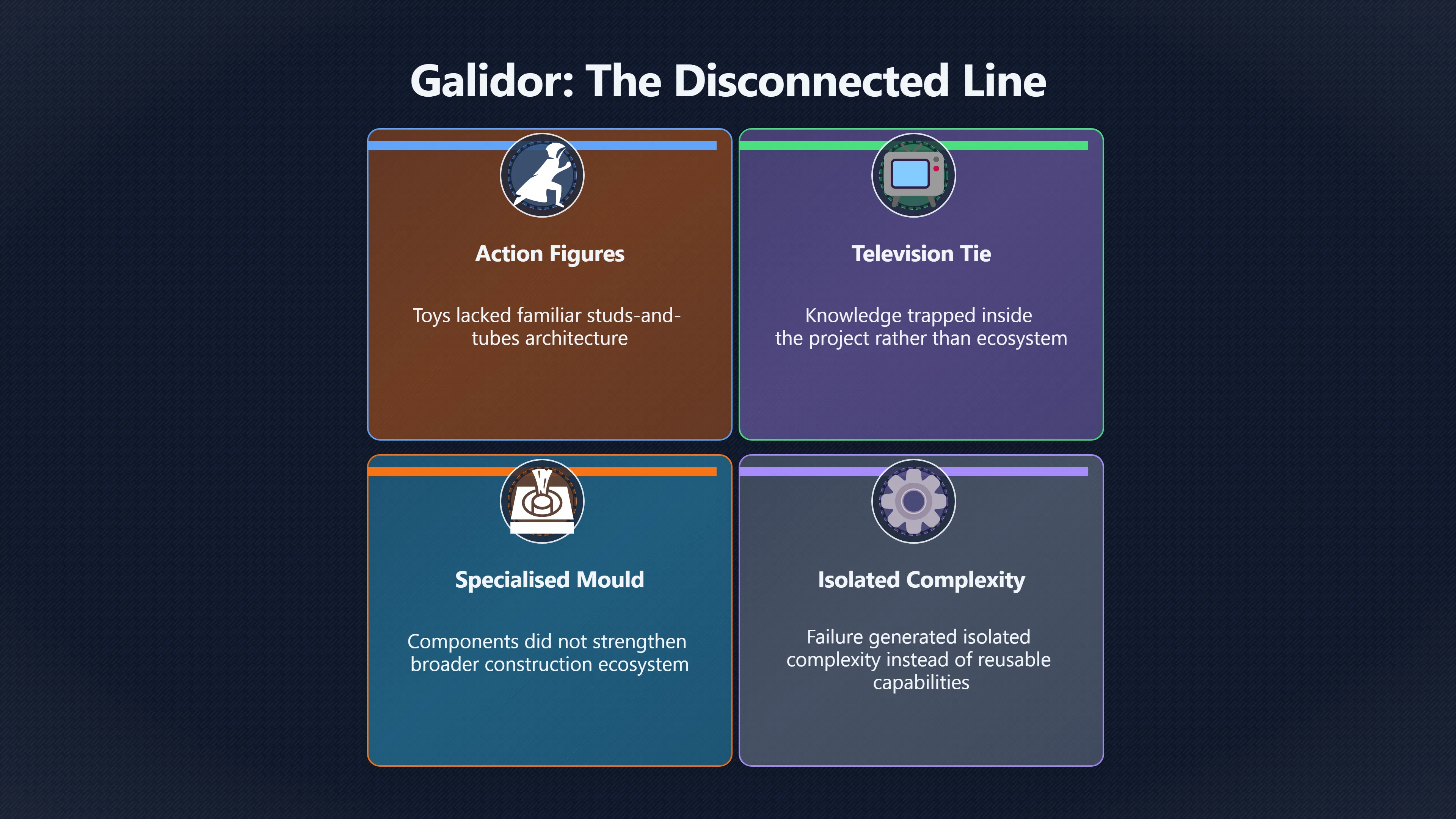
Galidor showed the cost of leaving the system
Galidor became the clearest example of a product carrying the LEGO name without benefiting from the LEGO system.
The line was built around television-driven action figures with interchangeable body parts rather than traditional brick construction. LEGO later acknowledged that the toys lacked the familiar studs-and-tubes architecture associated with the core building experience. Critics and fans frequently described the range as feeling disconnected from what made LEGO distinctive in the first place.[Wikipedia]WikipediaBrick by Brick: How Lego Rewrote the Rules of InnovationBrick by Brick: How Lego Rewrote the Rules of Innovation
The deeper problem was organisational rather than aesthetic. Knowledge created by Galidor was difficult to reuse elsewhere. The specialised moulds, television tie-ins, action-figure mechanics and category assumptions did not strengthen the broader construction ecosystem. If the experiment failed, much of the learning remained trapped inside the project.
That made failure expensive. Instead of generating reusable capabilities, the venture generated isolated complexity.[Harvard Business Review]hbr.orgHarvard Business ReviewInnovating a Turnaround at LEGOToday, as the overall toy market declines, LEGO's revenues and profits are climbing…
Clikits expanded the audience but weakened the connection
Clikits revealed a different version of the same mistake.
The line attempted to reach girls through jewellery, accessories and fashion-oriented customisation. As contemporary reporting noted, LEGO was trying to become a broader lifestyle brand while entering a market shaped by rapidly changing tastes.[campaignlive.co.uk]campaignlive.co.ukanalysis lego moves girls marketANALYSIS: Lego moves in on the girls' market13 Feb 2003 — As the toy firm bids to become a lifestyle brand, it enters a market of fast-ch…
The issue was not that girls were uninterested in building. The issue was that Clikits was structured around accessory creation rather than the open-ended construction logic that defined LEGO’s strongest products.
When consumers bought traditional LEGO themes, the pieces remained useful long after a specific set disappeared. Parts migrated into new creations and mixed with pieces from hundreds of other products. Clikits had far less of that cross-system value. Much of its appeal depended on the finished accessory rather than continued recombination.
From an antifragility perspective, this mattered because replayability is a learning mechanism. A child who rebuilds and recombines generates repeated feedback about parts, designs and possibilities. A product that ends its value at the moment of completion creates fewer opportunities for that learning cycle.
Theme parks carried the brand but not the operating logic
The LEGOLAND parks were not creative failures in the way Galidor was. Visitors often loved them. Yet they still exposed the distinction between brand extension and system extension.
Running parks required expertise in hospitality, attractions, property operations and visitor management. Those capabilities were largely separate from designing modular construction toys. When LEGO eventually sold the parks as part of its financial restructuring, the decision reflected an emerging recognition that a strong brand presence was not enough to justify ownership of a business that operated according to different economic rules.[Harvard Business Review]hbr.orgHarvard Business ReviewInnovating a Turnaround at LEGOToday, as the overall toy market declines, LEGO's revenues and profits are climbing…
The parks expressed the brand successfully. They did not necessarily strengthen the manufacturing, design and system advantages that drove LEGO’s core business.
How System Extension Protects Learning
The turnaround gradually replaced the question “Can LEGO enter this market?” with “Does this make the LEGO system stronger?”
That change encouraged experiments that produced reusable assets.
A system extension tends to create at least one of three forms of reuse:
- Part reuse: new elements remain compatible with existing products.
- Knowledge reuse: design lessons can improve future themes and sets.
- Community reuse: fan engagement, building techniques and creative behaviours spread across the ecosystem.
When an experiment creates those forms of reuse, even partial failure becomes valuable. The company retains something useful after the commercial outcome is known.
This logic helps explain why LEGO could successfully develop highly specialised themes without abandoning its core identity. Product lines such as Technic introduced new beams, pins and mechanical functions, but those innovations still expanded the construction system rather than replacing it. New capabilities entered the ecosystem while preserving compatibility.[Wikipedia]WikipediaOpen source on wikipedia.org.
That compatibility changes the economics of experimentation. A new element designed for one theme may later appear in dozens of others. Design knowledge gained in one product line can improve future products. The cost of failure decreases because learning remains available after a specific project ends.
Why Antifragile Experiments Need Reusable Feedback
Antifragility is not simply the ability to survive mistakes. It is the ability to become stronger because mistakes reveal useful information.
LEGO’s post-crisis approach increasingly favoured experiments that generated feedback loops instead of isolated outcomes.
A television series tied to a stand-alone toy line creates a relatively narrow feedback channel: consumers either buy the line or they do not. A modular building system creates many more signals. LEGO can observe which parts are reused, which themes inspire fan creations, which building techniques spread through communities and which components appear repeatedly in user-generated designs.
Those signals accumulate because the system remains connected.
This is one reason the LEGO fan community became strategically important during the turnaround. Engagement from builders did more than market products. It generated information about how people actually used the system. Because fans worked within a shared architecture of compatible parts, their experiments produced insights LEGO could reuse. The learning stayed inside the ecosystem instead of disappearing when a single product ended.[Wikipedia]WikipediaLego TechnicLego Technic
The distinction becomes clearer when comparing a closed product with an open building system. A closed product succeeds or fails as a unit. A building system creates thousands of small experiments conducted by users themselves. The company gains far more opportunities to learn from variation, modification and unexpected use.

Governance After the Crisis
The lasting lesson was not “stay with the brick” in a narrow sense. It was that innovation should strengthen the network around the brick.
Jørgen Vig Knudstorp’s leadership period is often described as a return to LEGO’s core. That description is partly accurate but incomplete. The company did not stop experimenting. Instead, it developed stricter filters for deciding which experiments deserved resources. The brick, the system of play and the surrounding community became reference points for evaluating new opportunities.[historyforoperators.substack.com]historyforoperators.substack.comHow LEGO Nearly CollapsedHistory for OperatorsKnudstorp drew a big red circle around LEGO's core business – the interlocking brick system and the play experiences…
Under that logic, a proposal had to answer more than a marketing question. It had to answer a systems question:
- Does this create reusable components?
- Does it deepen building behaviour?
- Does it generate knowledge that can improve future products?
- Does it connect to the broader ecosystem rather than standing apart from it?
Those questions transformed innovation governance. They reduced the risk that growth would create disconnected complexity and increased the chance that even unsuccessful projects would leave useful capabilities behind.
In antifragile terms, LEGO learned that the safest way to experiment was not to avoid failure. It was to design experiments whose failures could still strengthen the system. The crucial distinction was no longer whether an idea carried the LEGO brand. It was whether it added value to the LEGO system.[Harvard Business Review]hbr.orgHarvard Business ReviewInnovating a Turnaround at LEGOToday, as the overall toy market declines, LEGO's revenues and profits are climbing…[Harvard Business Review]hbr.orgHarvard Business ReviewInnovating a Turnaround at LEGOToday, as the overall toy market declines, LEGO's revenues and profits are climbing…
Amazon book picks
Further Reading
Books and field guides related to The Test LEGO Learned From Its Flops. Use these as the next step if you want deeper reading beyond the article.
Good to Great
Broad lessons on disciplined growth relevant to LEGO’s flops and recoveries.

Brick by brick
Explores LEGO’s strategic choices around expansion and core system strength.
The Secret Life of Lego Bricks: The Inside Story of a Design...
Contextualises LEGO’s product decisions and system evolution.
eBay marketplace picks
Marketplace Samples
Example marketplace items related to this page. Use the search link to explore similar finds on eBay.


Endnotes
1.
Source: Wikipedia
Title: Brick by Brick: How Lego Rewrote the Rules of Innovation
Link:https://en.wikipedia.org/wiki/Brick_by_Brick%3A_How_Lego_Rewrote_the_Rules_of_Innovation
2.
Source: historyforoperators.substack.com
Title: How LEGO Nearly Collapsed
Link:https://historyforoperators.substack.com/p/the-lego-turnaround
Source snippet
History for OperatorsKnudstorp drew a big red circle around LEGO's core business – the interlocking [brick system]({{ 'brick-system/' | relative_url }}) and the play experiences...
3.
Source: Wikipedia
Link:https://en.wikipedia.org/wiki/Galidor
4.
Source: campaignlive.co.uk
Title: analysis lego moves girls market
Link:https://www.campaignlive.co.uk/article/analysis-lego-moves-girls-market/170455
Source snippet
ANALYSIS: Lego moves in on the girls' market13 Feb 2003 — As the toy firm bids to become a lifestyle brand, it enters a market of fast-ch...
5.
Source: Wikipedia
Title: Lego Technic
Link:https://en.wikipedia.org/wiki/Lego_Technic
6.
Source: d3.harvard.edu
Title: the lego success story getting everything to awesome
Link:https://d3.harvard.edu/platform-rctom/submission/the-lego-success-story-getting-everything-to-awesome/
Source snippet
LEGO Success Story: Getting Everything to Awesome!28 Nov 2015 — The secret sauce of LEGO's financial turnaround has been successfully twe...
7.
Source: hbr.org
Link:https://hbr.org/2009/09/innovating-a-turnaround-at-lego
Source snippet
Harvard Business ReviewInnovating a Turnaround at LEGOToday, as the overall toy market declines, LEGO's revenues and profits are climbing...
8.
Source: hbr.org
Title: innovation under constraint constructing a turnaround at lego
Link:https://hbr.org/podcast/2016/10/innovation-under-constraint-constructing-a-turnaround-at-lego
Source snippet
Harvard Business ReviewInnovation Under Constraint: Constructing a Turnaround at...4 Oct 2016 — Harvard Business School professor Jan Ri...
Additional References
9.
Source: scribd.com
Link:https://www.scribd.com/document/946402250/LEGO-Innovation-Case-Study
Source snippet
LEGO's Innovation Turnaround Strategy | PDFThis case study explores the LEGO Group's transformation from a struggling wooden toy manufact...
10.
Source: strategyzer.com
Link:https://www.strategyzer.com/library/legos-great-business-model-turnaround-story
Source snippet
LEGO's Great Business Model Turnaround StoryLearn how LEGO pulled off a spectacular business turnaround, quadrupled its revenues in less...
11.
Source: designnews.com
Link:https://www.designnews.com/design-engineering/legos-unconventional-ventures-from-galidor-to-brittle-bricks-engineering-missteps
Source snippet
LEGO's Odd Ventures & Mishaps16 Jul 2025 — Explore LEGO's experimental product lines and engineering challenges, from the infamous Galido...
12.
Source: youtube.com
Link:https://www.youtube.com/watch?v=GMJCKI9ibrA
Source snippet
LEGO's Great Business Model Turnaround StoryWe tell the story of Lego's spectacular business turnaround. Find more of our topical, innova...
13.
Source: youtube.com
Link:https://www.youtube.com/watch?v=iHns2Fwpszo
Source snippet
Lego Galidor Review: Nick BluetoothHow's it going everyone! Today marks the first video in a series of Galidor set reviews! First, we wil...
14.
Source: theguardian.com
Title: how lego clicked the super brand that reinvented itself
Link:https://www.theguardian.com/lifeandstyle/2017/jun/04/how-lego-clicked-the-super-brand-that-reinvented-itself
Source snippet
How Lego clicked: the super brand that reinvented itself4 Jun 2017 — The revival of Lego has been hailed as the greatest turnaround in co...
15.
Source: markhub24.com
Title: lego strategic turnaround through innovation and focus
Link:https://www.markhub24.com/post/lego-strategic-turnaround-through-innovation-and-focus
Source snippet
LEGO: Strategic Turnaround Through Innovation and Focus15 Dec 2025 — The company achieved a strategic turnaround by refocusing on its cor...
16.
Source: helpmegrow.co.uk
Title: the lego turnaround a masterclass in business revival
Link:https://helpmegrow.co.uk/the-lego-turnaround-a-masterclass-in-business-revival/
Source snippet
The LEGO Turnaround: A Masterclass in Business Revival11 Dec 2024 — LEGO's remarkable turnaround offers valuable insights into how strate...
17.
Source: nowgocreate.co.uk
Link:https://nowgocreate.co.uk/blog/brick-by-brick-the-lego-innovation-matrix/
Source snippet
Brick by brick – how to use the Lego innovation matrix10 Mar 2023 — The matrix includes four quadrants: Core; Adjacent; Transformational...
18.
Source: reddit.com
Link:https://www.reddit.com/r/mealtimevideos/comments/w1bq8x/lego_galidor_the_toy_that_almost_bankrupted_lego/
Source snippet
zed interdimensional travel by means of a spaceship called the Egg...
Topic Tree